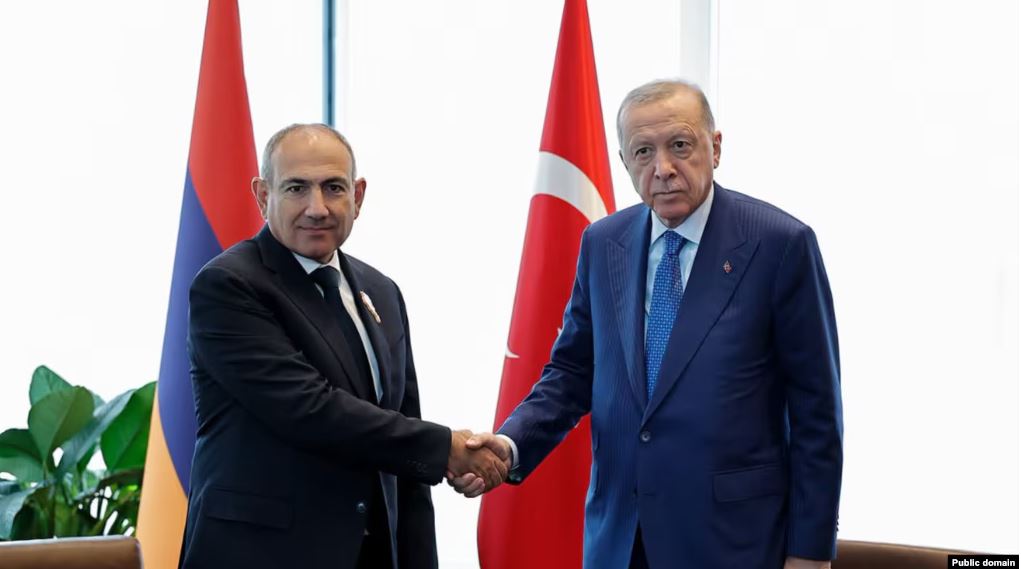
Armenian Prime Minister Nikol Pashinyan met with Turkish President Recep Tayyip Erdogan in New York on Wednesday, September 23, with the two leaders discussing Armenian-Turkish relations, regional transportation projects and the Armenia-Azerbaijan process.
The meeting took place at the Turkish House on the sidelines of the 81st session of the United Nations General Assembly. Turkish Foreign Minister Hakan Fidan also participated in the talks.
According to the Armenian government, Pashinyan and Erdogan discussed the normalization of Armenian-Turkish relations and the implementation of previously reached agreements. The two sides called for giving new impetus to relations, expanding trade and economic ties, developing contacts between Armenian and Turkish business communities and continuing work on the joint restoration of the historic Ani Bridge.
The Armenian government also said the two leaders discussed the TRIPP project, the U.S.-backed transportation initiative through southern Armenia, and the broader opening of regional transportation links. Under the Armenia-U.S. framework governing TRIPP, Armenia is to retain sovereignty, territorial integrity and jurisdiction over the project areas located on Armenian territory.
The Turkish presidency issued its own account of the meeting, saying Erdogan expressed support for normalization in trade and transportation and called for maintaining what Ankara described as the positive momentum in relations with Armenia. Erdogan also welcomed developments between Armenia and Azerbaijan and said growing cooperation between Armenia and Turkey in international organizations contributes to normalization. He invited Pashinyan to attend the COP31 Leaders’ Summit in Turkey.
Despite years of talks and increasingly frequent contacts between Armenian and Turkish officials, however, Turkey’s land border with Armenia remains closed to regular traffic. Turkey unilaterally closed the border in 1993, and Armenia and Turkey still do not have full diplomatic relations. Armenian officials said earlier this month that the renovated border facilities on Armenia’s side are fully prepared to begin operations whenever Ankara agrees to open the frontier.
Even a limited agreement reached in July 2022 to allow third-country nationals to cross the Armenian-Turkish land border has yet to be implemented. More than four years after that agreement was announced, no date has been set for regular crossings under its terms.
The continued closure comes as Ankara has repeatedly linked normalization with Armenia to developments between Yerevan and Baku.
In November 2025, Turkish Foreign Minister Hakan Fidan stated explicitly that Turkey would be ready to fully normalize relations and open its border with Armenia after Armenia and Azerbaijan sign a final peace agreement. Fidan also referred at the time to Azerbaijan’s demands concerning Armenia’s Constitution and the transportation route connecting Azerbaijan with Nakhichevan.
That linkage remained visible this year. In June, Fidan said Turkey’s normalization process with Armenia was continuing “in close coordination with Azerbaijan” and said Ankara expected Azerbaijan’s concerns to be addressed as part of the process leading to a final Armenian-Azerbaijani agreement.
The distinction is significant because, despite repeated official references to the establishment of “peace” between Armenia and Azerbaijan, the Armenian-Azerbaijani peace agreement has still not been formally signed. Its text was initialed in Washington in August 2025, but Azerbaijan continues to demand changes to Armenia’s Constitution before signing the treaty. Armenian government representatives have disputed Baku’s contention that the existing Constitution prevents the agreement from being signed.
Wednesday’s Armenian-Turkish meeting produced no announcement that Turkey will open the border, establish diplomatic relations with Armenia, or implement the still-pending 2022 border agreement.
Instead, the public statements from both governments again emphasized economic cooperation, transportation links and continued normalization talks, while the central unresolved issue in Armenian-Turkish relations, the continued closure of the border by Turkey, remained unchanged.