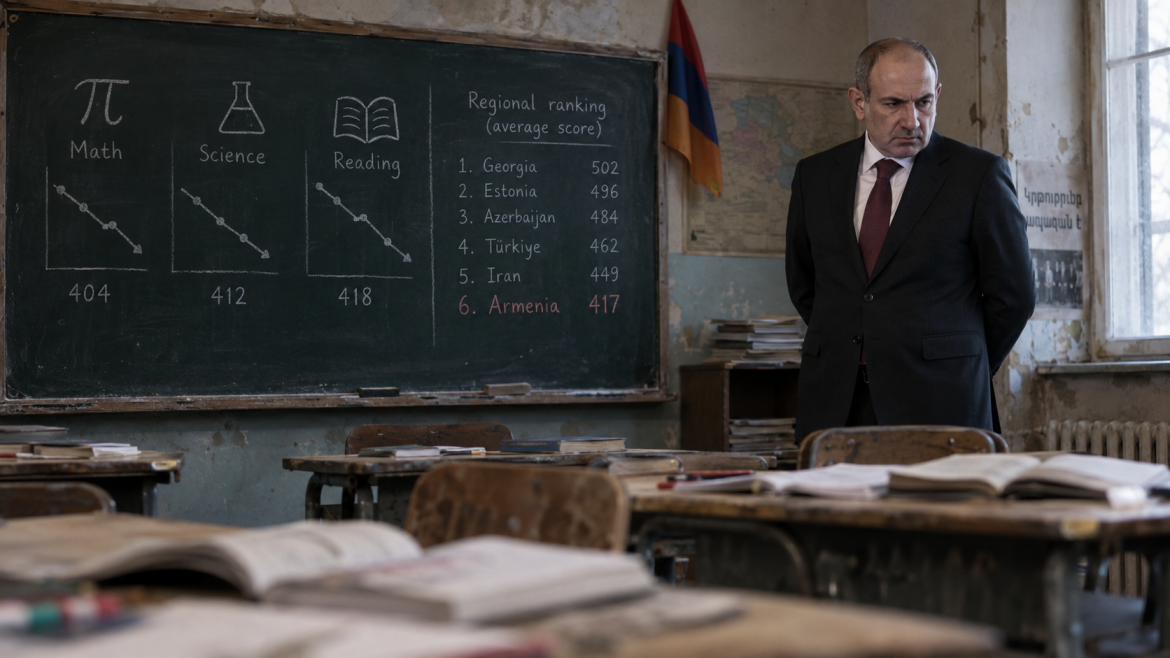
Armenia’s latest international education results paint an alarming picture of a school system that has deteriorated dramatically under Nikol Pashinyan’s government, leaving Armenian students behind neighboring countries that Armenia once substantially outperformed.
The contrast with Armenia’s performance under previous administrations is striking.
During Robert Kocharyan’s presidency, Armenian eighth-grade students scored 478 in mathematics and 461 in science in the 2003 international assessment. By 2007, those results had risen to 499 in mathematics and 488 in science.
More importantly, Armenia held a considerably stronger position within the region.
In 2007, Armenia’s mathematics score of 499 was far ahead of Turkey’s 432 and Georgia’s 410. In science, Armenia scored 488, compared with 454 for Turkey and 421 for Georgia.
Nearly two decades later, that regional standing has been reversed.
In the latest international assessment, Armenian 15-year-olds scored just 376 in mathematics, 369 in science and 348 in reading. Armenia now trails Georgia, Azerbaijan and Turkey across all three subjects.
The proficiency figures are even more disturbing. Only 28 percent of Armenian students demonstrated basic proficiency in mathematics and science. In reading, just 19 percent reached the basic proficiency threshold.
In other words, roughly four out of five Armenian 15-year-olds failed to demonstrate basic reading proficiency.
This cannot easily be blamed on governments of the distant past. The students tested were approximately seven or eight years old when Pashinyan came to power in 2018. Most of their formal education has therefore taken place under his government.
The results come after years in which Pashinyan’s government has disrupted Armenia’s educational system, altered curricula, weakened traditional educational standards and increasingly injected its ideological and political priorities into schools.
Pashinyan himself acknowledged in 2022 that functional illiteracy had become a national security problem. Four years later, international testing has demonstrated just how serious that problem has become.
The historical comparison is difficult to dismiss. Under Kocharyan, Armenia was performing near the international midpoint in mathematics and science and substantially outperforming major regional competitors. Today, Armenia has fallen behind those same countries while an overwhelming majority of its teenagers cannot demonstrate even basic international reading proficiency.
For Armenia, this is not merely an education issue.
A small nation facing severe demographic, economic and national security challenges depends disproportionately on the quality of its human capital. Armenia cannot afford a generation unable to read proficiently, reason mathematically or compete scientifically.
The latest results are another measure of the broader dismantling taking place under Pashinyan: institutions weakened, standards lowered and a country that once competed from a position of relative strength increasingly falling behind its neighbors.