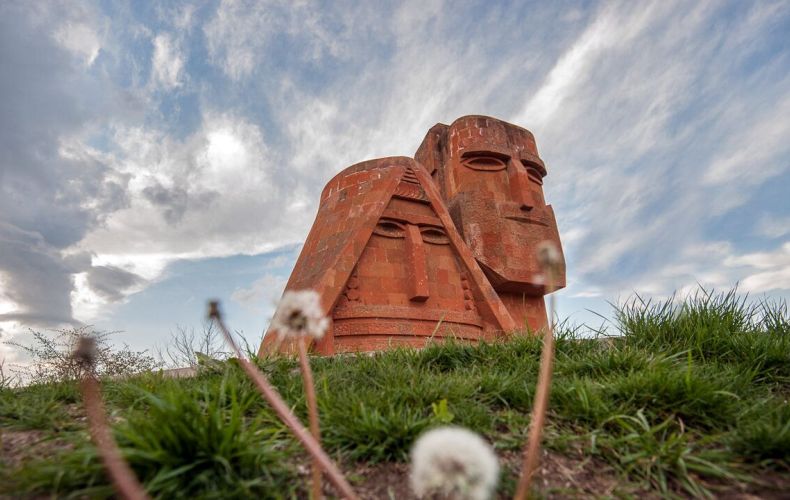
ARTSAKH AT THIRTY-FIVE: OUR HOMELAND EMPTIED
COURT FILES EXPOSE TURKEY’S JIHADIST PIPELINE TO BAKU
“AZERCOSMOS” ERASES ARMENIAN NAMES FROM ARTSAKH MAP
The Center for Armenian Research and Analysis (CARA) gathers and analyzes critical information on activities occurring in occupied Artsakh by state and non-state actors, and produces a weekly brief, with actionable data, to public and private stakeholders. Keeping Artsakh alive and in the public consciousness is part and parcel of CARA’s mission of providing clear and unfettered research and analysis pertaining to indigenous Armenian rights and cultural survival.
TOP ARTSAKH HEADLINES, AUGUST 31 – SEPTEMBER 6, 2026
Thirty-Five Years On: Artsakh Marks Its Independence Anniversary From Forced Exile
On September 2, 1991, representatives of the Nagorno-Karabakh Autonomous Region and the Shahumyan district adopted the joint declaration establishing the Nagorno-Karabakh Republic — Artsakh (Nagorno Karabakh) — as the Soviet Union collapsed around them. On December 10, 1991, an independence referendum returned 99.89% in favor, boycotted by the local minority Azeri population, and, in January 1992, a newly elected Artsakh Supreme Council formally adopted the declaration of independence, elected Artur Mkrtchyan its chairman, and established state institutions, a flag, a coat of arms, and a national anthem. Two decades of OSCE Minsk Group mediation produced no political settlement. On September 27, 2020, Azerbaijan launched a vicious offensive that became the 44-day Second Artsakh (Nagorno-Karabakh) War, ending in a Russia-brokered trilateral statement of November 9, 2020, which left Azerbaijan occupying the surrounding districts and most of Artsakh proper under the cover of Russian peacekeepers. In December 2022 Azerbaijan sealed the Lachin Corridor, the single road bridging Artsakh to Armenia, signaling the infamous and inhumane blockade of Artsakh and its entire indigenous population by Azeri forces for nine excruciating months. On September 19, 2023,Azerbaijan launched a final assault and new atrocities; Stepanakert was forced to disarm the following day; and within a week more than 150,000 indigenous Armenians — the entire surviving population — were forcibly deported from their millennial homeland. Thirty-five years after the declaration, there is no Armenian administration in occupied Stepanakert, no commemoration anywhere in Artsakh, and no population left to hold one in the, now, ethnically cleansed once thriving republic. For the forcibly displaced, September 2nd has become a symbol of homeland loss, reigniting the right of return, and an urgent call to document the cultural record before it is permanently erased.
That urgency is not sentimental. Occupied Armenian Nakhichevan is the tragic finished product of this same program: a millennial, indigenous Armenian territory purged of its native Armenians, its cultural life and landmarks destroyed to the point that the land is stripped of every trace of its people and of the world heritage that stood on it, the ancient Armenian cemetery of Djulfa and its khachkars included. Artsakh is where that sinister template is now being applied, and the anniversary of a declaration of independence has become, in the space of thirty-five years, a race to record what the occupier has not yet had time to demolish. What the date still carries, and what no occupation extinguishes, is the right of return and self-determination of the more than 150,000 ethnically cleansed indigenous Armenians of Artsakh, a bastion of Armenian life for thousands of years — rights that belong to a people, and that survive the emptying of the land to which they belongxzx z≈,. (Sources: Armenian Report Article, Asbarez Article)
“A War of Words” at the Hakari Bridge: Armenian Officials Deny an Azeri Advance and Attack the Newspaper That Reported It
The Armenian newspaper *Aravot quoted Suren Amaryan, acting administrative head of the Kornidzor settlement in the Tegh community, as saying that Azerbaijani forces had attempted to advance toward the strategically important Hakari Bridge, the crossing that once connected Armenia to Artsakh. Amaryan described the episode as “a war of words” rather than a violent one, with Azerbaijani forces pressing a claim to sovereign Armenian territory that Armenian residents rejected, and said border guard troops were “handling it.” Syunik province and the Tegh community administration then officially denied that any new advance had taken place, accusing Aravot’s reporters of having “misrepresented themselves as employees of the International Committee of the Red Cross” to reach Amaryan, and asserted the incident had “actually occurred four years ago.” Aravot answered by releasing a six-minute audio recording of the interview, in which Amaryan explains that border delimitation is urgently needed in Tegh to clarify boundaries after previous Azerbaijani advances following the Second Artsakh (Nagorno-Karabakh) War, and names the Hakari Bridge area as a prime example of where delimitation must occur. He is nowhere heard saying that the incident took place four years ago.
The sequence is the tell. Confronted with a local official describing an Azeri push onto sovereign Armenian ground, the Pashinyan regime’s provincial structures did not investigate the push — they denied it, backdated it by four years, and impeached the journalists who printed it, and, then, were contradicted by the recording. This is the governing reflex of a regime that spins news of Azeri encroachments rather than the dealing with encroachments as sovereigns, and it is precisely how border villages in Syunik have been and are being surrendered by increments: not by a decision anyone signs, but by a sequence of denials that leaves nothing on the record to defend. (Source: OC Media Article)
Yerevan Will Not Say Whether It Has Even Asked Baku to Let Anyone See the Hostages
The Armenian Ministry of Foreign Affairs has declined to say whether it has formally petitioned Azerbaijan to permit diplomats of a “neutral” third country to make a consular visit to the roughly two dozen Armenian hostages and prisoners of war illegally imprisoned and abused in Baku. Once again, exploiting the “sensitivity of the issue,” the Ministry claimed efforts are ongoing while refusing to identify the country or provide any detail. Siranush Sahakyan, the Yerevan-based attorney representing the hostages and POWs before the European Court of Human Rights (ECHR), said third-party access is of extreme importance precisely because the 19 named political hostages — including eight former leaders of Artsakh — have been held virtually incommunicado for over a year. The International Committee of the Red Cross (ICRC), which previously held exclusive access to inspect detention conditions, was forced to close its mission in Azerbaijan in September 2025, and some hostages are sometimes permitted to telephone their families once every 40 days. Families report serious physical injuries, abuse, and sharp declines in health; Sahakyan noted that the absence of access makes it impossible to verify whether those injuries were inflicted by violence as torture is rampant in Azeri penal culture, and Baku has released no official information whatsoever. A full year after Armenia and Azerbaijan initialed a draft peace treaty in Washington, the future of the hostages remains entirely uncertain, with previous prisoner experiences and disappearances pointing to a foreboding future.
What the Ministry’s non-answer actually concedes is this: the Armenian state will not confirm that it has even asked for access. The “sensitivity” invoked here is not the hostages’ sensitivity — it is the sensitivity of a Baku-centric peace agreement that the Pashinyan regime will not risk by pressing the one demand upon which the hostages’ survival depends. Eight former heads of a state–from the Republic of Artsakh–the very homeland that Armenia’s current regime has spent two years deleting from Armenia’s own vocabulary, are now held incommunicado and abused by the Azeri state that ethnically cleansed and emptied their homeland, and their own government cannot say out loud whether it has made a request on their behalf. (Source: Armenian Mirror-Spectator Article)
Armenian Court Files and UN Investigators Document Turkey’s State-Run Pipeline of Syrian Jihadists Into the 2020 War
Armenian court files and independent United Nations investigations describe a state-sanctioned proxy pipeline run by the government of Turkish President Recep Tayyip Erdogan, the Turkish National Intelligence Organization (MIT), and the Turkish military, built to recruit, train, and deploy Syrian jihadist fighters in service of Ankara’s regional aims. Recruits were drawn from economically destitute men in Turkish-controlled northern Syria by the Sultan Suleiman Shah Brigade under Muhammad al-Jasim (Abu Amsha), a militia commander enlisted by MIT to raise and train fighters for Azerbaijan’s campaign against Armenians, and promised monthly salaries of $2,000 to $2,500. Roughly, 500 or more underwent three months of training in Sheikh Hadid between June and September 2020 — months before the hostilities that began on September 27, 2020.
The logistics were state logistics. Cohorts were moved to crossings near Kilis and Bab al-Salam, where Turkish border guards let them cross without passports, identification, or questions — an instruction that can only have come from MIT. Inside Turkey, they were flown between Turkish airports on civilian aircraft, escorted by Turkish military personnel, then flown into Azerbaijan on aircraft bearing the Azerbaijani flag, issued Azerbaijani military uniforms and identification tags, and armed to obscure who they were on the battlefield, before being deployed to the front lines of the 44-day war and into sovereign Armenian territory in Syunik Province. Armenian prosecutors presented evidence that these mercenary recruits were promised a $100 bonus for presenting the severed head of an Armenian, supplied with long-bladed knives, and ordered to attack Armenian civilian villages, carry out arson, and terrorize the population.
Two Syrian nationals, Muhrrab Muhammad al-Shkheri and Yousef Alaabet al-Hajji, were captured by Armenian forces in 2020 and, in May 2021, sentenced to life in prison by the Syunik Provincial Court for terrorism, international terrorism, violations of international humanitarian law, and mercenary activity; both admitted they were hired mercenaries. On January 14, 2026, the Armenian government transferred both men through Turkey to Syrian authorities — without obtaining any guarantee that they would remain incarcerated — on the exact day Azerbaijan released four Armenian detainees, marking the transfer as a reciprocal exchange brokered through Ankara. Turkey and Azerbaijan officially deny the mercenary allegations, but the judicial record is corroborated by UN Special Procedures communications and by US Treasury sanctions, which in August 2023 designated Abu Amsha, the Sultan Suleiman Shah Brigade, and the Hamza Division for severe human rights abuses.
Two conclusions follow, and neither is in dispute in the files. First, Turkey was a co-belligerent in the Second Artsakh (Nagorno-Karabakh) War, not a sympathetic neighbor — a NATO member state that recruited, trained, transported, uniformed, and armed jihadist mercenaries for a war of conquest and genocide against an indigenous Christian Armenian population, and has since converted the Syrian National Army into a mobile, cheap, and deniable expeditionary pool that lets Ankara project force from Libya to the South Caucasus without spending Turkish lives. Second, the Pashinyan regime took two men convicted in an Armenian court of international terrorism against Armenian civilians and handed them back through the territory of the state that sent them, securing nothing in writing, in exchange for four of its own citizens Baku should never have been holding. The bounty on Armenian heads was entered into evidence in an Armenian courtroom, and the regime traded away the men who took it. (Source: Nordic Monitor Article)
Medical Terrorism and Forced Conversion: Baku Burns the Cross Off a Hostage’s Skin
Armenian hostages illegally held in Baku are being targeted for their Christian faith, consistent with the Azeri state’s standing policy of destroying, dismantling, and denigrating Armenian and Christian heritage. Documented abuses include torture to remove Christian symbols — the burning of a cross tattoo off a captive’s skin — and the denial of access to the Bible alongside being forced to read the Quran. Beyond the isolation described above, the men are denied outdoor walks and letter exchanges, and the monitored calls make plain that their health is in jeopardy, that proper medical care is not organized, and that medication is administered only temporarily, to mask symptoms rather than treat the conditions beneath them. Azerbaijan failed to meet an August 31st ECHR deadline to submit reports on the captives’ condition.
A review of the 3,300-page indictment and verdict of former Artsakh State Minister Ruben Vardanyan demonstrates that these trials are a complete sham: the Azeri judiciary has classified charitable and social work as criminal activity, including Vardanyan’s funding of school and kindergarten renovations, his sponsorship of a mass wedding in Artsakh, and the work of the Aurora Humanitarian Initiative. Vardanyan’s wife, Veronika Zonabend, has requested that Armenian authorities coordinate a humanitarian mission to Baku and establish consular services through a third country, and Siranush Sahakyan has appealed to the international legal and academic communities to examine published Azeri court documents before these unlawful proceedings harden into accepted global precedent without any justice or accountability .
Withholding treatment from prisoners whose survival is the precondition for every international case against Azerbaijan has a name. This is Medical Terrorism. And the indictment is worth reading exactly as Baku wrote it: a state that has criminalized the renovation of kindergartens and the sponsorship of weddings has told the world, in 3,300 pages of its own prose, that the offense being punished is Armenian life in Artsakh itself — the schools, the marriages, the children, the continuity. Burning a cross off a prisoner’s body is the same sentence written on skin. (Source: Asbarez Article)
UNICEF and the Afeyan Foundation Close Mental-Health Program for Children of Ethnic Cleansing Press Release Calls a “Crisis”
On September 4th, UNICEF Armenia marked the completion of its partnership with the Afeyan Foundation, which expanded mental health and psychosocial support (MHPSS) services for children, adolescents, caregivers, and frontline professionals. The program was launched in response to what the release calls “the September 2023 crisis,” during which, by UNICEF’s own count, more than 115,000 ethnic Armenian refugees — including 36,000 children — fled to Armenia. 2,017 adolescent peer support volunteers were trained in psychological first aid, mentorship, and referral, reaching a further 18,220 children and young people; 1,098 parents and social workers were trained and mobilized, reaching 26,044 more. Roughly,nmsd 2,000 children and young people took part in visual storytelling, theater, and music-based activities, and the program launched the Armenian version of uSupport, UNICEF’s anonymous digital MHPSS platform.
The work is real, the need is real, and the Afeyan Foundation funded it when the Armenian state did not. The vocabulary is the problem. What happened in September 2023 was not a “crisis” and the children are not weather refugees — they are the surviving children of more than 150,000 forcibly displaced, ethnically cleansed indigenous Armenians of Artsakh, deported at gunpoint after a nine-month blockade starved them. When a UN agency writes the cause out of the sentence, it hands Baku the thing Baku most wants: an aftermath with no perpetrator, a humanitarian file rather than a crime, and thirty-six thousand traumatized children with no one named as having traumatized them. (Source: UNICEF Press Release)
Azerbaijan’s Court of Appeals Rubber-Stamps the Sham Sentences Against Artsakh’s Leadership
Azerbaijan’s Court of Appeals rejected the appeals filed by Armenian hostages, among them the former high-ranking officials of Artsakh, who had sought to overturn the politically motivated verdicts handed down by the sham Baku Military Court. The ruling confirms a wholly compromised judicial system and the Aliyev regime’s effort to bury its violations of international humanitarian law beneath show trials. The underlying convictions were issued in February 2026: life sentences for former Artsakh President Arayik Harutyunyan, former Artsakh Defense Army Commander Levon Mnatsakanyan, and officials David Manukyan, Davit Ishkhanyan, and David Babayan; 20-year sentences for former Artsakh Presidents Arkadi Ghukasyan and Bako Sahakyan, reportedly capped at twenty only by age-based sentencing limits under Azeri law; and 15 to 19 years for the rest.
The appellate stage was never a chance at review; it is the procedural varnish the record requires before Baku can present these sentences abroad as the output of a court. An entire elected leadership of a democratic republic is being imprisoned for life for having governed it — and the appeal exists so that Azerbaijan can say the question was heard twice. (Source: Armenian Mirror-Spectator Article)
“On the Ground” in Occupied Artsakh
Digital Erasure: “Azercosmos” and a Foreign Analytics Firm Wipe Armenian Names Off the Map of Occupied Artsakh
On August 31st, Azercosmos, a company under Azerbaijan’s AZCON Holding, announced that it had worked with the international satellite data and analytics company EOS Data Analytics to update the base map of occupied Artsakh. The 11-month “cooperation and data exchange” process did one thing: it replaced the names previously displayed in Armenian with Azerbaijan’s toponyms, supplied from Azerbaijan’s Open Data Portal (Opendata.az) and an internal database Azercosmos describes as confirming “the correct names.” The Armenian cities and villages of Stepanakert, Martuni, Martakert, and Mataghis (Azeri “Sugovushan”) now appear on the digital map only under their occupation names — “Khankendi,” “Khojavend,” “Aghdara,” and “Sugovushan.”
This is cartographic ethnic cleansing, and it is the step that makes the physical erasure durable. A demolished church can be photographed; a renamed map is reproduced automatically, worldwide, by every downstream platform that ingests it, until the Armenian name is not contested but simply absent. Note, also, who performed the work: not the Azeri state alone, but a foreign commercial analytics firm that accepted an occupying power’s word for “the correct names” of settlements whose inhabitants that same power deported in 2023. This is what participation in genocide looks like when it is billed as a data-quality project. (Source: EOS Data Analytics)
Baku Claims 4,010 of Its Own Missing While Ignoring the Armenians It Disappeared
As of August 31st, Azerbaijan’s State Commission on Prisoners of War, Missing Persons, and Hostages claimed a total of 4,010 Azerbaijani citizens registered as missing from what it calls “the Karabakh conflicts” — 4,004 purportedly from the Artsakh Self Defense War (First Nagorno Karabakh War) and 6 from the Second Artsakh (Nagorno-Karabakh) War — with the first-war figure broken down as 3,222 military personnel and 782 civilians, the latter said to include 71 children, 288 women, and 319 elderly individuals. The Commission claims that it has located 32 mass graves, exhumed 910 sets of human remains, identified 328 people by DNA and forensic methods, and handed 267 of them to families. 3,682 individuals are still carried as missing.
By certain official reports, at least 80 Armenians have been forcibly disappeared and more than 200 more remain unaccounted for–although experts, NGOs, human rights groups, and researchers say the actual numbers of Armenian missing are much higher. Azerbaijan continues, unabashedly, to ignore its obligations to investigate or acknowledge those cases, while fabricating absurdly high numbers for Azeri missing persons. It is also important to note that during the Artsakh Self Defense War (First Nagorno Karabakh War), confirmed reports described how Azeri authorities, particularly special military and intelligence units, were notorious for killing, torturing, and disappearing their own in the theater of battle and in civilian scenarios when their forces refused to fight or attempted to retreat. A ledger built to that standard doesn’t document the missing; it builds the case Baku intends to make. (Source: Updated Statistics on Missing Persons)
The “Settlers Offensive” Advances: 117 Families Deployed Into Occupied Akna, and a Wedding Staged in Occupied Khachen
On September 1st, a further group of illegal Azeri settlers was deployed into the occupied city of Akna (Azeri “Aghdam”) under the settler-based operation Azerbaijan calls “The Great Return” — 362 people across 117 families to date, presented with the keys to their new apartments at a ceremony attended by the Azeri State Committee for Refugees and Internally Displaced Persons and the office of Azeri dictator Ilham Aliyev’s Special Representative for the occupied Akna, Varanda (Fizuli), and Martuni regions. The same day, a wedding was staged in the occupied village of Khachen (Azeri “Seyidbəyli”) in occupied Ivanyan (Azeri “Khojaly”) and promoted as “the first such ceremony in the village in 34 years.” The bride’s mother, Aziza Asadova, was relocated to occupied Khachen under the state settlement program; her daughter Aisha Mamishova married Sardar Ramazanov, a veteran of Azerbaijan’s so-called “44-day Patriotic War” who fought in occupied Martakert (Azeri “Aghdara”). Guests “paid solemn tribute to the memory of the martyrs” whose sacrifice, in the state’s telling, made the return possible.
These are indigenous Armenian villages, purged of their inhabitants in September 2023 and now being settled and repopulated, family by Azeri settler family, with keys handed over at welcoming ceremonies as part of Azerbaijan’s growing “Settlers Offensive,” a sinister part of their program of erasure of indigenous Armenians, their culture, and heritage. Experts hold that the “Settlers Offensive” is based on Israeli models and algorithms, and it is important to note that Israeli intelligence and military advisors and specialists have been directly involved, to a great degree and in numbers, across Azeri state and private sectors, particularly in the intelligence and defense communities. Note what the wedding is for: thirty-four years is measured from the moment Artsakh Armenians defended themselves against genocide and created a democratic state, and the ceremony’s function is to furnish the occupation with a birth date, a family album, and a claim of continuity on ground whose actual continuity was broken by deportation and violence three years ago. (Sources: Relocation to Occupied Aghdam, Wedding in Occupied Aghdara)
Baku Turns the 4th International Mine Action Conference Into an Indictment of Armenia
On September 2nd, at the 4th International Mine Action Conference in Baku, Azerbaijan’s Deputy Minister of Foreign Affairs, Samir Sharifov, claimed that “Armenia’s failure to provide complete and accurate mine maps” is what delays clearance and the “safe return” of Azeri settlers, and asserted that mine-planting “continued even after the conflict concluded in November 2020.” ANAMA Board Chairman Vugar Suleymanov claimed to have cleared more than 298,000 hectares in occupied Artsakh and to have neutralized over 260,000 mines and other explosive ordnance, of which over 103,000 hectares were cleared to support “residential infrastructure” — residential complexes, schools, and hospitals — all of it integrated into the occupation’s reconstruction and “urban recovery” since November 2020. Anar Guliyev, Chairman of Azerbaijan’s State Committee on Urban Planning and Architecture, made the integration explicit, presenting demining as an “integral part of planning and building safe, resilient, and sustainable communities” in which spatial planning determines the expansion of settlements and the placement of public and economic zones — a framework actively supported through cooperation with the United Nations Human Settlements Programme (UN-Habitat) — and cited 437 Azerbaijani civilians killed or injured by landmines since 2020. Separately, Farid Shafiyev of the Center for Analysis of International Relations (AIR Center) called the mine question “a critical political problem” going “beyond a purely humanitarian concern” that directly conditions normalization and dismissed Yerevan’s explanation that the 1990s maps were poorly prepared, and further claimed many mines were laid in 2021 and 2022 by people “still active or with direct knowledge of the layouts” — from which he accused Armenia with a “clear lack of political will.”
The figures are Baku’s own and cannot be independently verified. They are published by the Azeri state to anchor the false narrative that Artsakh’s occupied and ethnically cleansed territories are a post-war “humanitarian theater” rather than the site of genocide, and to underwrite the programmatic Azeri settlement that follows every clearance team activity. Guliyev said the quiet part in the language of urban planning out loud: demining, spatial planning, and settlement are one program, and the power grids, “smart” utilities, and master-planned construction that follow are not civilian development — the buildout expands and buttresses Turkish Azeri military, logistics, and intelligence designs for regional hegemony and future territorial aspirations at a foundational and dangerous level. Shafiyev’s contribution completes the inversion: the Azeri state that conquered the territory of Artsakh, deported its population, and now builds settlements on the indigenous Armenian homeland is, here, the aggrieved party, and Armenia’s obligation is to make the conquest easier to occupy. (Sources: Sharifov Comments, Mine Clearance in Occupied Artsakh, Guliyev Comments, AzerNews Article)
A Nineteenth-Century Armenian Cemetery in Occupied Shushi Is Demolished for a Wastewater Plant
On September 6th, the non-governmental organization Caucasus Heritage Watch (CHW) reported that an old Armenian-Russian cemetery in occupied Shushi was demolished between May 9 and 14, 2026, and linked the demolition directly to the construction of a rainwater and wastewater treatment facility on the cemetery grounds. The site held five Armenian khachkars created several centuries before the burials around them, and CHW had documented 35 gravestones dated between 1810 and 1871 carrying the vital records of Armenian families, craftsmen, Russian military personnel, doctors, and civil servants of nineteenth-century Shushi — among them Vladimir Mikhailov, commander of the 42nd Jaeger Regiment who defended Shushi in 1826, and Sofia Regina Reander, born in Moscow.
A cemetery is a land title written in stone, which is why this one had to go. The khachkars predate the graves by centuries, and the graves themselves document a continuous, documented, multi-ethnic Armenian city — precisely the record that must be absent before Shushi can be presented as an Azeri town with an Armenian interlude. The pretext is instructive: not a monument, not a museum, but a wastewater plant, chosen because infrastructure is the one category of destruction that no international body will ever call cultural. This is the Djulfa method, applied inside a city Azerbaijan invites journalists to visit. (Source: Demolition of Armenian Cemetery in Occupied Shushi)
The Occupation Eats Its Own: An Azeri Contractor Is Threatened With Arrest for Asking to Be Paid
On September 6th, an Azerbaijani contractor, Nasimi Hatamov, head of NIHAT 2024 LLC, accused Paramount Construction LLC of failing to pay his company for reconstruction work completed in the occupied village of Astghashen (Azeri “Dashbulag”) under an AZN 3.4 million (USD 2 million) contract — work carried out as Azerbaijan has allocated roughly AZN 22 billion (USD 13 billion) to the occupied territories’ so-called “post-war restoration” since 2020. After police refused to intervene, Hatamov posted a video appeal to social media; Anar Mammadov, head of the Baku firm Tutto Bella, promised payment if he deleted it, then reneged three weeks later. The office of Aliyev’s Special Representative in occupied Stepanakert summoned Hatamov to meetings, promised payment within a week, paid nothing, and stopped answering his calls, and both the police and that office threatened him with arrest and deportation — despite his Azerbaijani citizenship — unless the video came down. He now cannot pay his 28 employees, owes AZN 17,000 to 18,000 (USD 10,000–11,000) in taxes, and has had his car seized by creditors. He has said he will not delete it.
The detail worth holding is the threat of deportation issued to a citizen — an administration on occupied ground that has assumed the power to expel people it dislikes, having already done exactly that to everyone who lived there. USD 13 billion does not flow into ethnically cleansed territory through open procurement; it flows through a patronage machine on stolen land, where the office of the dictator’s representative is simultaneously the client, the arbitrator, and the enforcer. Hatamov’s grievance is real and his treatment is squalid, and it is also a window: if this is what the occupation does to an Azerbaijani citizen with a signed contract, the question of what it did to the Armenians who owned that land answers itself. (Source: OC Media Article)
Foreign Interests and Actions in Occupied Artsakh
Turkish Firms Move Into “Green” Energy on Occupied Armenian Land, With the Power Bound for Europe
On August 31st, the State Agency for Renewable Energy Sources (AREA) under Azerbaijan’s Ministry of Energy met with members of t