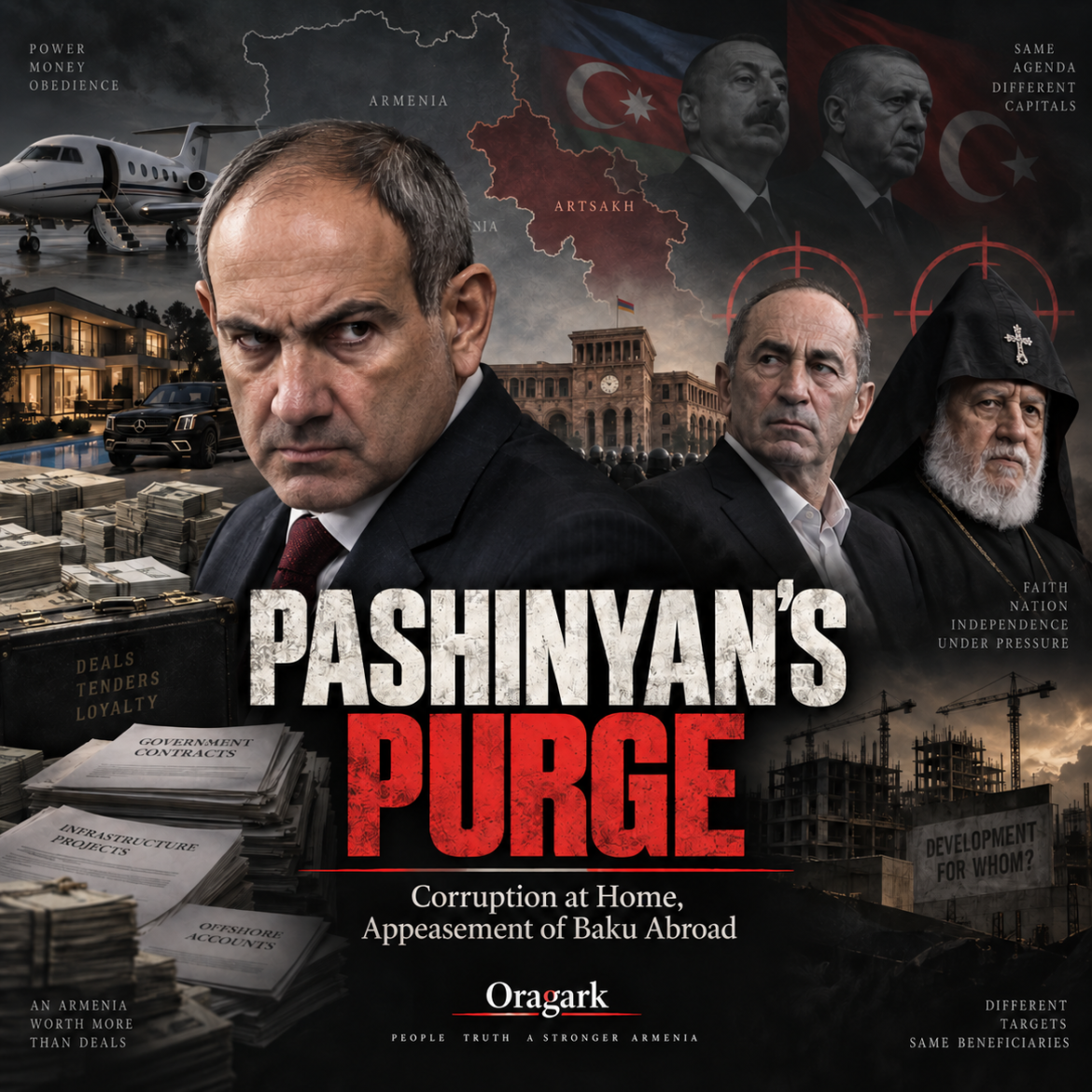
As corruption questions increasingly surround Nikol Pashinyan’s ruling establishment, his government has chosen two extraordinarily convenient enemies: Robert Kocharyan and the Armenian Apostolic Church.
The timing is not merely politically useful at home. It also serves the interests of Ilham Aliyev and Recep Tayyip Erdogan.
Kocharyan and Catholicos Karekin II represent two of the strongest remaining centers of opposition to Pashinyan’s concessions to Azerbaijan. Both have defended Armenian national claims and the rights of Artsakh Armenians. Both are now under intense pressure from a government that increasingly portrays resistance to its policies as an obstacle to “peace.”
Baku has made its preferences clear. During Armenia’s 2026 election campaign, Azerbaijani pro-government media openly favored Pashinyan and attacked Kocharyan and other opponents as dangerous “revanchists.” Aliyev himself warned Armenians against returning such forces to power.
Pashinyan has used strikingly similar language.
He has portrayed Kocharyan and the opposition as a “war party.” He has also accused the leadership of the Armenian Apostolic Church of obstructing peace with Azerbaijan, while openly seeking the removal of Catholicos Karekin II.
The political alignment is difficult to ignore.
At the same time, the corruption story inside Armenia is increasingly becoming a Pashinyan-era story.
Hetq and other investigative outlets have reported on questionable transactions involving senior Civil Contract figures and politically connected businessmen. Civil Contract parliamentary leader Hayk Konjoryan faced scrutiny over a home purchase reportedly made substantially below market value. Deputy Prime Minister Mher Grigoryan’s delegation spent approximately $77,000 in public funds flying aboard a private aircraft linked to the family of Civil Contract MP Khachatur Sukiasyan.
The Armenian National Interests Fund, created under Pashinyan, became embroiled in investigations involving millions of dollars in public money.
Most recently, Hetq reported that prosecutors are seeking approximately $637,000 in allegedly illicit assets from former Yerevan Deputy Mayor Karen Davtyan, a founding shareholder in the controversial Pallada Tsaghkadzor development. Another shareholder was Edgar Avagyan, the godfather of the son of senior Pashinyan ally Alen Simonyan.
Meanwhile, Armenia’s anti-corruption record has stagnated. Transparency International has reported virtually no meaningful improvement in recent years.
And this is when Pashinyan suddenly rediscovers Robert Kocharyan.
Kocharyan left office in April 2008.
Eighteen years have passed.
Pashinyan has been in power for more than eight years, backed by a parliamentary majority and a state apparatus over which he exercises enormous political influence. Independent monitors have repeatedly raised concerns about selective justice and political pressure on Armenia’s judiciary.
For eight years, Pashinyan’s government has had access to prosecutors, investigators, banking records, property registries, tax records and every other state resource available to investigate Kocharyan.
Kocharyan was not hiding abroad. He remained in Armenia, participated openly in political life and twice emerged as Pashinyan’s leading electoral opponent.
Yet only in August 2026 did prosecutors suddenly unveil a sweeping new case alleging bribery, money laundering and abuse of office dating to Kocharyan’s presidency between 1998 and 2008.
The credibility problem is compounded by Pashinyan’s own conduct.
During the election campaign, he publicly said Kocharyan would end up in prison.
Then the election ended.
Kocharyan was arrested.
A prime minister cannot publicly predict, or effectively promise, the imprisonment of his principal political opponent and then expect the public to regard the resulting prosecution as independent justice.
After eighteen years, after eight years of hostile scrutiny and after previous prosecutions failed to produce a corruption conviction, Kocharyan remains innocent. The government has produced allegations, not proof.
And Kocharyan’s identity matters.
He was the first president of the Republic of Artsakh.
Today, Artsakh’s former leaders are imprisoned in Baku, while its first president is imprisoned in Yerevan.
That outcome could hardly be more convenient for Aliyev.
Baku has spent years attempting not merely to conquer Artsakh, but to erase the legitimacy of the Artsakh movement itself. Removing Kocharyan from Armenian political life directly serves that objective.
The confrontation with the Armenian Apostolic Church follows the same pattern.
The Armenian Constitution explicitly recognizes the Church’s unique national role, yet Pashinyan has openly sought to remove the Catholicos while senior clergy face criminal proceedings.
Why?
Because the Church has continued to speak about Artsakh, ethnic cleansing, Armenian national rights and the dangers of concessions to Azerbaijan.
Weakening the Church means weakening one of the last major Armenian institutions capable of resisting Pashinyan’s effort to redefine Armenia’s national agenda around accommodation with Baku and Ankara.
That is what connects these developments.
Pashinyan faces growing questions about corruption and patronage inside his own governing system.
At the same time, Aliyev and Erdogan want an Armenia in which the Artsakh issue is buried, opposition to concessions is marginalized and independent national institutions are weakened.
Targeting Kocharyan and the Catholicos serves both purposes.
It changes the subject at home while advancing the political outcome Baku wants abroad.
No secret document from Aliyev is necessary to recognize the result.
Pashinyan is criminalizing the old Artsakh leadership, attacking the Armenian Church and portraying opposition to further concessions as opposition to peace.
Eight years after promising to eliminate corruption and political persecution, his government increasingly looks like a system using both as political tools.
At home, it looks like repression.
From Baku, it looks like victory.
And from Ankara, it looks like normalization.