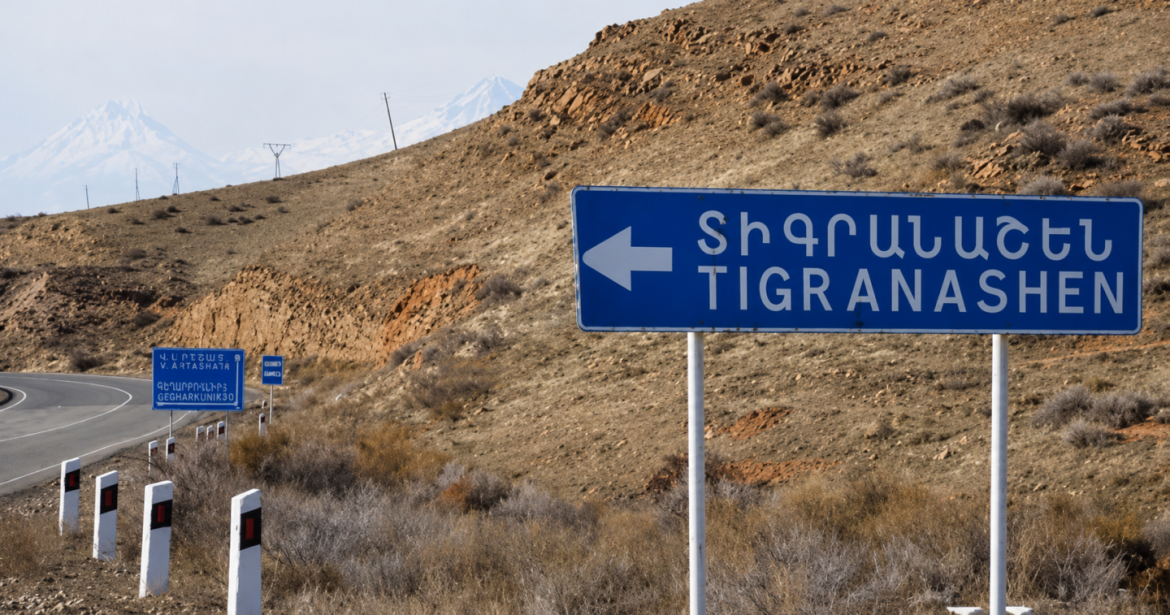
Prime Minister Nikol Pashinyan has taken another significant step toward preparing the Armenian public for the possible handover of Tigranashen to Azerbaijan, publicly declaring that the strategically located village is not Armenian territory according to the maps his government has adopted for border delimitation.
Speaking to journalists on August 20, Pashinyan referred to Tigranashen by the Azerbaijani name “Kyarki,” stating that while Artsvashen is Armenian territory, “Kyarki,” Barkhudarlu and Yukhari Askipara are not. He added that the question of the former enclaves will ultimately have to be resolved through negotiations.
The terminology itself was revealing. Pashinyan did not merely acknowledge Azerbaijan’s claim to Tigranashen. Armenia’s prime minister adopted Baku’s name for the village while presenting its claim as a cartographic reality. Azerbaijani media immediately highlighted the remarks as confirmation that Yerevan recognizes the territory as Azerbaijani.
No final agreement transferring Tigranashen has been announced. But Pashinyan’s statements appear to be laying the political groundwork for such an outcome by first convincing Armenian society that the territory should not be regarded as Armenian in the first place.
Tigranashen is particularly sensitive because of its strategic location. The village lies along the M2 interstate highway connecting Yerevan with Vayots Dzor, Syunik and Iran. A transfer to Azerbaijani control would therefore affect not only the residents of the village but an important transportation artery linking Armenia’s capital to the country’s south.
ARF member and Armenia Alliance deputy Kristine Vardanyan has warned that Azerbaijan’s interest in Tigranashen cannot be separated from its strategic importance. She has pointed to the contradiction of the Armenian government now questioning the sovereignty of territory where Armenia has administered communities and held elections for decades.
Pashinyan justifies his approach through the 1991 Alma-Ata Declaration and Soviet administrative maps, arguing that Armenia cannot demand the return of Artsvashen while refusing to address former Azerbaijani enclaves.
But the supposed symmetry is deeply misleading. Azerbaijan continues to occupy Armenian sovereign territory seized during its 2021 and 2022 incursions, while Artsvashen itself remains under Azerbaijani control. Yet once again, it is Yerevan discussing what Armenia should surrender, with no equivalent Azerbaijani withdrawal secured in advance.
The pattern is becoming familiar. In Tavush, Pashinyan’s government first told Armenians that disputed territories were not truly theirs, then presented withdrawal as unavoidable in the name of peace and delimitation. Tigranashen now appears to be entering the same process.
The danger is not only the potential loss of another Armenian-controlled territory. It is a negotiating policy in which Baku makes demands, Pashinyan gradually adopts the language behind those demands, and Armenian society is then told to accept the resulting concessions as inevitable.
Once Armenia’s own prime minister publicly declares that Tigranashen is not Armenian, the question risks shifting from whether it should be surrendered to merely when and how.
For Azerbaijan, that is already a substantial victory.