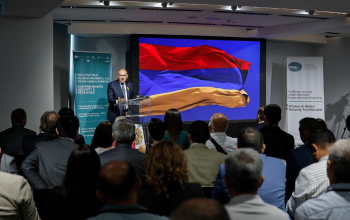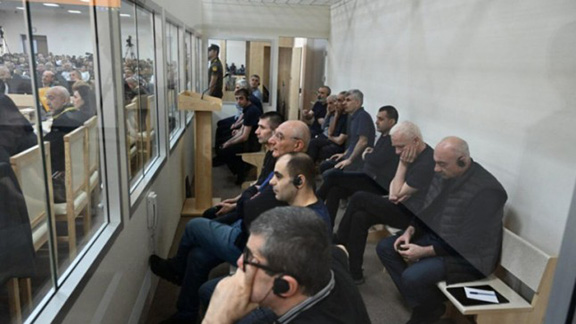
The events unfolding simultaneously in Baku and Yerevan offer a disturbing picture of Nikol Pashinyan’s Armenia: Azerbaijan continues imprisoning Artsakh’s former leaders and openly dictating changes to Armenia’s Constitution, while Pashinyan’s government intensifies prosecutions against political opponents and has now brought the Catholicos of All Armenians before the courts.
On Thursday, an Azerbaijani appeals court upheld the sentences imposed on seven former political and military leaders of Artsakh who were captured following Azerbaijan’s September 2023 assault and the forced displacement of Artsakh’s Armenian population. Five received life sentences and two were sentenced to 20 years. Amnesty International has described the trials of the Armenian prisoners as a “travesty.” Davit Ishkhanyan, one of those sentenced, said the defendants appealed largely to exhaust domestic remedies before seeking recourse in international courts.
Their imprisonment is especially damning in light of the agreement Pashinyan has pursued with Azerbaijan. Neither the Armenian-Azerbaijani peace treaty initialed in Washington nor the accompanying declaration requires Baku to release the Armenian prisoners. Despite repeated assurances from Yerevan that it is working for their freedom, Artsakh’s former leaders remain in Azerbaijani prisons with no clear path to release.
Baku, meanwhile, is not behaving like a government that believes the concessions are finished. Azerbaijani presidential aide Hikmet Hajiyev openly said this week that Baku is receiving “signals” that Armenia will soon begin the process of adopting a new constitution. Azerbaijan has long demanded removal of the constitutional link to Armenia’s Declaration of Independence because the declaration references the 1989 Armenia-Artsakh reunification decision. Hajiyev made clear that Baku views such a change as a condition for formally signing the peace agreement.
Pashinyan continues to insist that his push for a new constitution is not being carried out at Azerbaijan’s demand. Yet the sequence speaks for itself: Baku demands a constitutional change, Pashinyan campaigns for precisely such a change, and Azerbaijani officials then announce publicly that they are receiving signals from Yerevan that the process is moving forward.
There is, however, a political obstacle. Civil Contract does not control the two-thirds parliamentary majority required to approve a new constitution before sending it to referendum. Opposition votes may therefore become decisive. Opposition leaders have already warned that the government could seek to pressure lawmakers into providing the necessary support.
That warning comes as Pashinyan’s government continues an extraordinary campaign of arrests and prosecutions against its political adversaries. Former parliamentarian Aregnaz Manukyan remains in pretrial detention, accused of passing classified information to opposition leader Andranik Tevanyan. She denies the allegation and, despite not herself being charged with high treason, has for weeks been prohibited from seeing or even speaking by telephone with her 13-year-old daughter. Dozens of opposition figures, members and supporters have been arrested in recent months, while Pashinyan himself repeatedly threatened during the election campaign to jail leaders of major opposition forces.
Now the confrontation has reached the highest level of the Armenian Apostolic Church.
Catholicos Karekin II and six senior bishops are scheduled to appear in court Friday on accusations that they failed to comply with a civil court order temporarily reinstating defrocked Bishop Gevorg Saroyan, who had aligned himself with Pashinyan and demanded Karekin II’s resignation. The defendants face up to two years in prison. Legal experts and Church officials have raised serious questions about whether the state is violating the constitutionally protected autonomy of the Armenian Apostolic Church by using secular courts to intervene in matters of internal ecclesiastical discipline.
The prosecution comes after years of escalating attacks by Pashinyan against the Church and after the arrests and prosecutions of several prominent clergymen who challenged his government. Reuters described the case against Karekin II as the most significant legal challenge yet to the leadership of the Armenian Apostolic Church and noted accusations that it forms part of a broader pattern of selective justice against government critics.
Catholicos Aram I of the Great House of Cilicia issued a forceful statement Thursday condemning the proceedings. He called summoning Karekin II to court “unacceptable and condemnable,” revealed that he had personally advised the Catholicos to consider sending a representative rather than appearing himself, and appealed to Armenia’s authorities to show proper respect toward the Armenian Church and its pontiff while respecting both state law and the Church’s internal canonical order.
The significance of Aram I’s intervention should not be understated. The dispute can no longer credibly be dismissed as merely a personal confrontation between Pashinyan and Karekin II. Concern over state interference has spread across the Armenian Church and Diaspora, with bishops and dioceses in the United States, Canada, Europe and the Middle East publicly condemning or questioning the prosecution.
The contrast is stark. Azerbaijan imprisons the leaders of Artsakh, demands changes to Armenia’s foundational documents and publicly announces what it expects Yerevan to do next. Pashinyan offers no comparable confrontation with Baku. Instead, the coercive power of the Armenian state is increasingly being directed inward—against opposition leaders, political activists and now the leadership of the Armenian Apostolic Church.
This is the increasingly recognizable architecture of Pashinyan’s “peace agenda”: accommodation abroad and coercion at home. Baku sets new conditions, while those Armenians most capable of organizing resistance to those conditions find themselves fighting criminal cases, sitting in detention or being summoned before the courts.