The Armenian government has approved a controversial agreement granting the United States sweeping authority over a proposed transit route through southern Armenia, despite an official Justice Ministry assessment concluding that key provisions of the deal conflict with Armenian law.
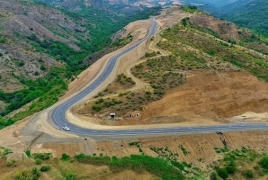
The agreement establishes the framework for the so-called Trump Route for International Peace and Prosperity, or TRIPP, which would connect Azerbaijan with its Nakhichevan exclave and Turkey through Armenia’s Syunik region, along the strategically sensitive Armenian-Iranian border.
Under the arrangement, a newly created joint venture would manage a railway, highway, energy lines and other infrastructure along the route for a minimum of 49 years. The United States government would control 74 percent of the Trump Route Development Company, which would be granted exclusive land-use, development and operational rights necessary to administer the project.
Although Armenian authorities insist that the country will retain formal sovereignty and jurisdiction over its territory, the practical arrangements outlined in the agreement have raised serious questions regarding the actual extent of Armenian control.
The deal envisions a “front office/back office” system at border crossings with Azerbaijan. Private operators selected by the U.S.-controlled company would perform services involving travelers and cargo, while Armenian border guards and customs officials would be assigned a less visible, secondary role.
According to the Armenian Justice Ministry’s legal opinion, this arrangement is incompatible with the country’s existing Law on the State Border. Armenian law reserves the authority to inspect documents, process persons and cargo, and authorize passage through the state border exclusively for Armenian state agencies.
The ministry also found that proposed tax exemptions for the Trump Route Development Company and its subsidiaries contradict Armenian tax legislation.
Despite those conclusions, the Justice Ministry recommended that the government approve the agreement for what it described as political considerations. The government formally approved the deal on Thursday.
The agreement itself reportedly states that its provisions will take precedence in the event of a conflict with Armenian law. It must still be reviewed by Armenia’s Constitutional Court before being submitted to parliament for ratification.
The disclosure has reinforced criticism that Prime Minister Nikol Pashinyan’s government is moving forward with a far-reaching geopolitical arrangement before resolving its fundamental legal and constitutional implications.
Azerbaijani President Ilham Aliyev has repeatedly demanded unobstructed passage through Armenian territory and has said Azerbaijani travelers should not encounter Armenian border guards while using the route. Pashinyan has indicated that his government is prepared to accommodate that demand through technological systems designed to eliminate direct contact between Armenian officers and Azerbaijani passengers.
Critics argue that such concessions increasingly resemble the extraterritorial “Zangezur corridor” long demanded by Baku, regardless of the terminology used by Armenian and American officials.
Trump Donor Selected to Lead $201 Million Fund
Questions surrounding the project have deepened following reports that the United States has selected Russian-born American businessman Konstantin Sokolov to chair a $201 million investment fund connected to the Trump Route initiative.
The Tripp+ Enterprise Fund is expected to provide loans, grants and equity investments aimed at supporting strategic private-sector projects in the South Caucasus and Central Asia.
Sokolov, a Chicago-based private equity investor, is reportedly among dozens of donors who contributed to U.S. President Donald Trump’s White House ballroom project. He has also donated more than $12 million to Republican political campaigns and organizations during Trump’s second term.
The businessman already has significant interests in Armenia. He co-owns one of the country’s three mobile telecommunications operators and reportedly expressed interest earlier this year in acquiring a major Armenian mining enterprise previously controlled by Russia’s VTB Bank.
The selection of a politically connected foreign businessman with existing commercial interests in Armenia to oversee the Trump Route investment fund is likely to fuel further concerns regarding transparency, political influence and the distribution of economic benefits associated with the project.
The Armenian public has received limited information about how the fund will operate, how investments will be selected, what financial obligations Armenia may assume, and whether individuals connected to the project could benefit from privileged access to state assets or infrastructure.
Iran’s Concerns Remain Unanswered
Iran has consistently opposed the Trump Route, warning that the initiative could create a long-term American strategic or security presence along the Armenian-Iranian border and weaken Armenia’s effective control over Syunik.
The Iranian ambassador to Armenia recently stated that Yerevan had still not provided satisfactory answers to Tehran’s concerns, describing them as legitimate and logical.
Nevertheless, Pashinyan has declared that his government intends to implement the project as quickly as possible.
The proposed route is therefore emerging not merely as a transportation or economic initiative, but as a major restructuring of Armenia’s geopolitical environment. It would give the United States a dominant role in managing critical infrastructure along Armenia’s southern frontier while providing Azerbaijan with a privileged transit connection to Nakhichevan and Turkey.
The government’s decision to proceed despite acknowledged conflicts with Armenian law raises a central question: whether Armenia is shaping the project as a sovereign state or adapting its laws, institutions and border arrangements to satisfy commitments already made to foreign powers.
With the agreement awaiting Constitutional Court review and parliamentary ratification, the government will face growing demands to disclose the complete legal, financial and security consequences of the project.
At stake is not simply the management of a road or railway. It is Armenia’s authority over its borders, its strategic relationship with Iran, the future of Syunik and the limits of foreign control over sovereign Armenian territory.