By Harut Sassounian
TheCaliforniaCourier.com
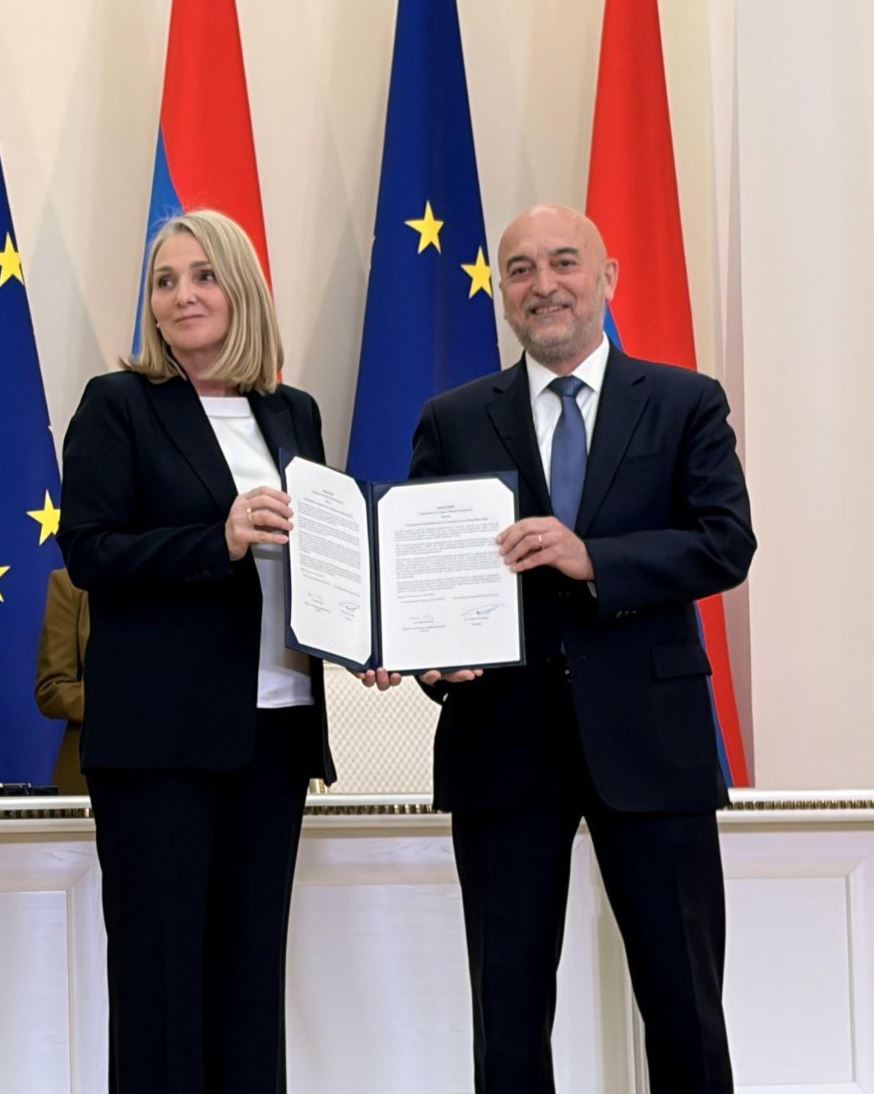
Finally, some good news from Armenia. In a positive development, the European Commission signed the first-of-their-kind “Letters of Intent” with six Armenian organizations during the EU-Armenia Summit in Yerevan on May 5. The document was titled “Cooperation for People-to-People Connectivity.”
The signing ceremony was held at the Armenian Presidential Palace in the presence of Pres. Vahagn Khachaturyan, Prime Minister Nikol Pashinyan, European Commission President Ursula von der Leyen, and European Council President Antonio Costa.
The Letter with the AGBU was signed by Adrienn Kiraly, European Commission’s “Director for Eastern Neighborhood and Turkey,” and Vasken Yacoubian, President of the Armenia Chapter of the Armenian General Benevolent Union (AGBU) and a member of AGBU’s Central Board.
The Letter stated that both sides “express their interest in exploring possible cooperation to contribute to stronger economic and societal links between Armenia and the European Union.” It explained that “The Armenian Diaspora has strong communities across Europe and globally in business, research, culture, and public policy. AGBU, the largest Armenian Diaspora non-profit organization, has a long-standing track record in education, entrepreneurship support, and international cooperation, supported by a broad international network.”
The purpose of this joint effort is to “explore cooperation to help mobilize the Armenian Diaspora in support of investment, mentorship, and strong partnerships between the European Union and Armenia. This cooperation could also build on AGBU’s Armenia Virtual College to reinforce digital outreach and engagement.”
The six Armenian organizations that signed the EU Letters of Intent were:
— “Amber Capital Armenia: Mobilizing private equity to connect Armenian SMEs [Small and Medium-sized Enterprises] with European capital and standards;
— Synopsys Armenia: Strengthening semiconductor skills and links between education and industry, benefiting Armenia and the European Union’s competitiveness;
— Firebird.ai: Developing strategic digital and energy connectivity to position Armenia as a regional digital hub;
— TUMO Center for Creative Technologies: Scaling digital and creative skills for the next generation;
— AGBU: Boosting people-to-people links and Diaspora-driven investment;
— Creative Armenia: Expanding creative industries and connections with European cultural networks.”
The Letter, described by the EU website as a “non-binding agreement,” explained that it “does not create any legal or financial obligations for either party. It represents a declaration of intent and an openness to explore cooperation, with the understanding that any future collaboration would remain subject to further discussion, applicable procedures, the availability of resources, and the conclusion of any final agreements.”
In a lengthy interview, Vasken Yacoubian of AGBU spoke with journalist Anush Trvants about the signed Letter and other important issues. The interview was published exclusively by the Istanbul-based Armenian newspaper Jamanak.
Yacoubian commended the EU for appreciating the potential of the Diaspora through this initiative. Asked if this indicated that previous Armenian attempts had not been fully successful, Yacoubian disagreed. He stated that during previous governments, when there was a Diaspora Ministry, substantial work was done. “The potential of the Diaspora is enormous,” he said.
When asked about recent intra-Armenian tensions, the problems with the Church, internal divisions, and polarization, Yacoubian explained that when Armenia’s internal problems are taken overseas, the Diaspora gets confused. “These issues relate to our identity, the Genocide, putting a question mark on Artsakh, and other problems. Unfortunately, divisions have also begun to arise in the Diaspora around these subjects.”
Yacoubian then stated: “Our [AGBU’s] work is always with the state in favor of statehood, regardless of who is in power at the time. This does not mean at all that we agree with all the steps of the authorities, but, we cannot sit back and simply boycott, saying that since we disagree on an issue, therefore, we will not cooperate. That’s the wrong approach. At the same time, there are many other areas where we consider the work done by the authorities to be correct…. Maintaining this balance is quite difficult, but this role is not new for us. We have always had it and will continue to play that role, contrary to various opinions. We are convinced that 70% of our national potential is in the Diaspora. Is it wise to ignore that force, when we have important political or military goals before us, and time, unfortunately, is working against us?”
In answer to a question about Istanbul Armenians, Yacoubian said: “I visited Istanbul about two or three years ago…. I went, and I can say that I returned amazed and delighted, because I saw a community that has firmly clung to its environment, convinced that it is at home, and not a Diaspora in the classical sense…. But I also experienced heartache because we, as a nation, including our Union [AGBU] and the government of Armenia, have not been able to develop a serious strategy for collaborating with and cultivating relations with the Armenian community of Istanbul.”
Answering a question about whether there will be a solution to the government’s attacks on the Church, Yacoubian said: “We consider the Armenian Apostolic Holy Church to be the most important pillar of our identity. …We hope the solution will be correct and just in favor of the Armenian nation. After all, the Armenian Church serves the Armenian nation. Our Church is different in its essence. When we talk about the potential of our people, and emphasize that we will use that potential in the right direction, then in order to achieve our goals in the shortest possible time, we must not forget that our Church has enormous potential, both in Armenia and in the Diaspora. Throughout the Diaspora, each Church and flock is a separate potential, and the Diaspora itself is united around the Church. So, why ignore or try to undermine the foundations of this potential?”