Contributor Analysis Special to the Center for Armenian Research and Analysis (CARA)
An initial look at Armenian politics presents a perplexing question: How has Nikol Pashinyan remained politically dominant despite military defeat, territorial loss, national humiliation, and recurring political crises?
Many explanations focus on familiar political factors. Armenia faces serious security challenges. The opposition seems fragmented and often unpopular. Voters may simply view the available alternatives as unconvincing. These explanations undoubtedly matter. Yet, they do not fully capture the deeper psychological transformation that appears to have taken place in Armenian society since the 2020 “Forty-Four Day War.”
The puzzle is not simply why Pashinyan remains in power. It is why the level of public mobilization and political confidence that characterized 2018 appears so difficult to recreate today.
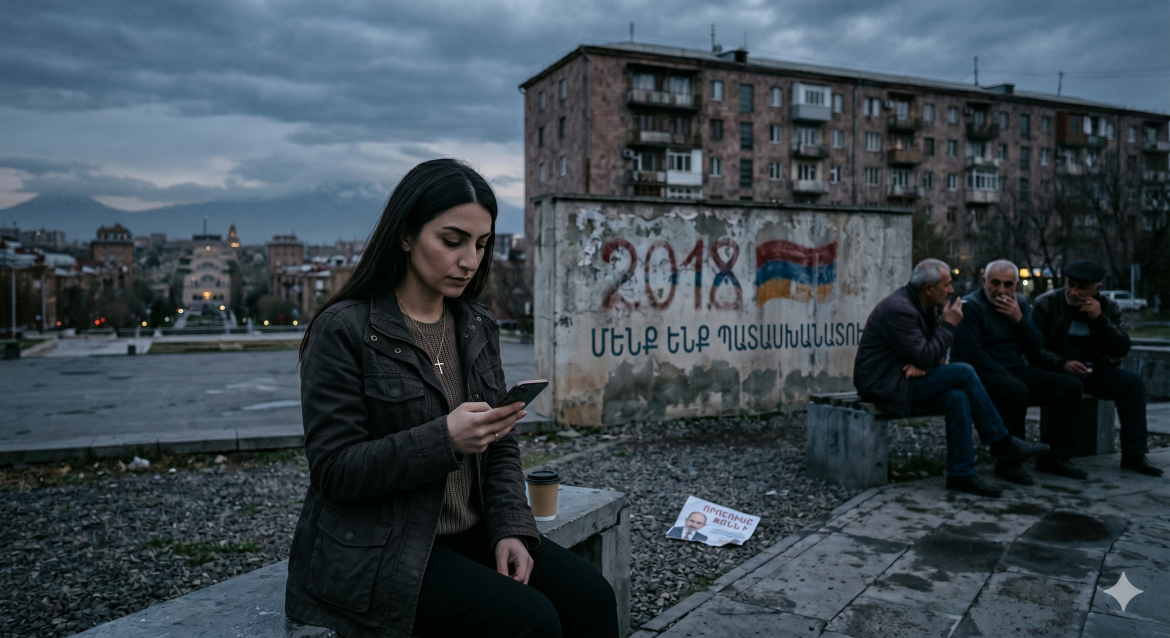
The Armenia of 2018 was defined by political optimism. Hundreds of thousands of citizens participated in, what has been termed, a “Velvet Revolution” believing that meaningful change was possible. This movement seemed to not only bringing down a long-entrenched political order, but generated a widespread sense of political agency. Ordinary citizens felt that their actions mattered. Politics ceased to be something imposed from above and seemed to be something that could be shaped from below.
For many Armenians, the “Velvet Revolution” represented more than a change in government. It was seen as a reaffirmation of democratic possibility.
The years that followed produced a dramatically different reality.
The 2020 war, the loss of Artsakh, continuing security concerns, and a series of deeply polarizing political controversies shattered many of the assumptions that had animated the “revolutionary” moment. Questions surrounding national identity, relations with the Armenian Apostolic Church, and the erosion of long-standing national aspirations and symbols further intensified social divisions. Regardless of one’s political position, the period after 2020 has been marked by profound uncertainty and collective disorientation.
The consequences of such events are often discussed in terms of trauma. This is certainly appropriate. The defeat in the war and the subsequent developments that followed constitute not merely geopolitical setbacks, but psychological ones. Long-held assumptions regarding security, identity, and national destiny suddenly appeared fragile.
Yet, trauma alone may not explain the political atmosphere that followed.
Another possibility deserves consideration: the idea of collective shame.
Unlike anger, shame often produces withdrawal rather than action. Anger directs attention outward toward those perceived as responsible for a problem. Shame directs attention inward. It is associated with self-doubt, avoidance, and silence.
This distinction may be important in understanding post-war Armenia.
Many of the citizens most distressed by developments since 2020 are not detached observers. They are individuals who actively participated in bringing Pashinyan to power. They marched, organized, protested, and invested emotionally in the promise of political transformation. If the outcome of that “transformation” was later perceived as disappointing, harmful, or even disastrous, the resulting emotions may be more complicated than simple political dissatisfaction.
Acknowledging disappointment in a leader is one thing. Acknowledging disappointment in a movement one helped create is something else entirely.
Doing so may require confronting uncomfortable questions. Was the “revolution” misguided? Were expectations unrealistic? Were critical warning signs ignored? Could different choices have been made?
Such questions are not merely political. They are deeply personal.
For some individuals, openly revisiting them may threaten their sense of judgment, identity, or political self-understanding. Under these circumstances, political disengagement can become psychologically easier than political confrontation. Silence becomes less painful than reflection.
This dynamic may help explain one of the most striking features of contemporary Armenian politics: the contrast between the civic energy of 2018 and the relative political quiet that followed.
The disappearance of mass mobilization should not automatically be interpreted as evidence of satisfaction. Nor should political quiet necessarily be confused with political approval.
It may instead reflect exhaustion.
Psychologists use the term learned helplessness to describe situations in which repeated experiences of failure, disappointment, or powerlessness lead individuals to conclude that meaningful change is impossible. Even when opportunities for action remain available, motivation declines because people no longer believe their actions will produce different outcomes.
The concept was originally developed to explain individual behavior, but similar dynamics can emerge at the collective level.
For many Armenians, the political question may no longer be, “How can we improve our future?” but rather, “How can we avoid making things worse?”
Once politics becomes organized around fear rather than aspiration, public expectations begin to contract. Citizens cease searching for ideal outcomes and instead focus on minimizing risk. Elections become exercises in damage control rather than opportunities for transformation.
It is important not to overstate this argument. The existence of collective shame, political resignation, or learned helplessness does not imply the complete disappearance of political engagement. Political parties, activists, volunteers, and ordinary citizens continue to organize, campaign, debate, and advocate for competing visions of the country’s future. Such activity serves as an important reminder that political agency has not vanished.
Indeed, the official results of Armenia’s most recent parliamentary election demonstrate precisely this point. Voter participation remained substantial, political competition persisted, and the electorate “officially” delivered a governing majority to Nikol Pashinyan’s Civil Contract party. (Note: At publication of this article, electoral results are increasingly being contested with cases of blatant fraud and irregularities being brought to light.) The result itself does not validate or invalidate the argument presented here. Elections may reveal political outcomes; they do not necessarily reveal the psychologicalprocesses that shape them.
The official election outcome also raises an important interpretive question. Electoral victory is often treated as evidence of public approval and a mandate for the prevailing political course. Yet, such conclusions are not always warranted. Citizens frequently vote under conditions of uncertainty, fear, strategic calculation, or dissatisfaction with available alternatives. A vote for continuity is not necessarily a vote of confidence. It may instead reflect the belief that existing alternatives are unconvincing, risky, fragmented, or incapable of producing better outcomes. Under such circumstances, electoral success reveals who won the contest; it does not necessarily reveal widespread enthusiasm for the direction in which the country is headed.
If anything, the election underscores the distinction between political participation and political confidence. Citizens may continue to vote, campaign, and engage in public life while simultaneously holding diminished expectations about the range of achievable alternatives. High levels of participation can coexist with uncertainty, risk aversion, and skepticism about the possibility of meaningful change. The relevant question is, therefore, not whether Armenians remain politically engaged, but how they understand the possibilities that politics can realistically deliver.
A society may remain politically active while experiencing a narrowing of political imagination. Under such conditions, electoral continuity does not necessarily reflect enthusiasm. It may instead reflect caution, uncertainty, the absence of trusted alternatives, or a broader reluctance to risk further disappointment. The persistence of an incumbent government, after repeated national crises, therefore, does not resolve the puzzle addressed in this essay—it sharpens it.
Support for incumbents may reflect neither confidence nor approval. It may instead reflect diminished expectations, uncertainty about alternatives, and a broader loss of faith in political agency itself.
This possibility echoes insights developed by Herbert Marcuse, Theodor Adorno, and Max Horkheimer, among others. Their concern was not simply how power is exercised, but how societies adapt to conditions they once considered unacceptable. Over time, people may come to regard constrained possibilities as normal and limited alternatives as inevitable.
Applied to Armenia, this raises a troubling possibility. The most significant consequence of the post-war period may not be continued support for any particular leader. It may be the narrowing of political imagination itself.
When disappointment turns into resignation, and when resignation evolves into learned helplessness, the range of conceivable alternatives begins to shrink. Citizens remain politically free, yet increasingly struggle to imagine paths different from the present one.
This is why the central issue may not ultimately be Nikol Pashinyan.
The deeper question concerns the condition of Armenian society after war, displacement, and repeated political disappointments. The challenge facing Armenia is not only institutional or geopolitical. It is psychological.
Post-conflict societies must rebuild more than infrastructure and state capacity. They must also rebuild confidence in collective agency. Democratic resilience depends not only on elections and political parties, but on citizens who believe that alternative futures can be imagined, debated, and pursued.
For Armenia, recovery may therefore require more than political change. It may require overcoming the trauma, shame, and resignation that limit the ability of citizens to envision themselves as agents of change once again.
The enduring puzzle of post-war Armenia is not simply why one leader remains in power after repeated crises. It is whether a society that once demonstrated extraordinary political confidence can recover the imagination and civic trust necessary to believe in alternatives again.
The Center for Armenian Research and Analysis (CARA) is a trans-national research institute that provides investigative, analytic, and informational resources to public and private entities across the Armenian experiential spectrum.