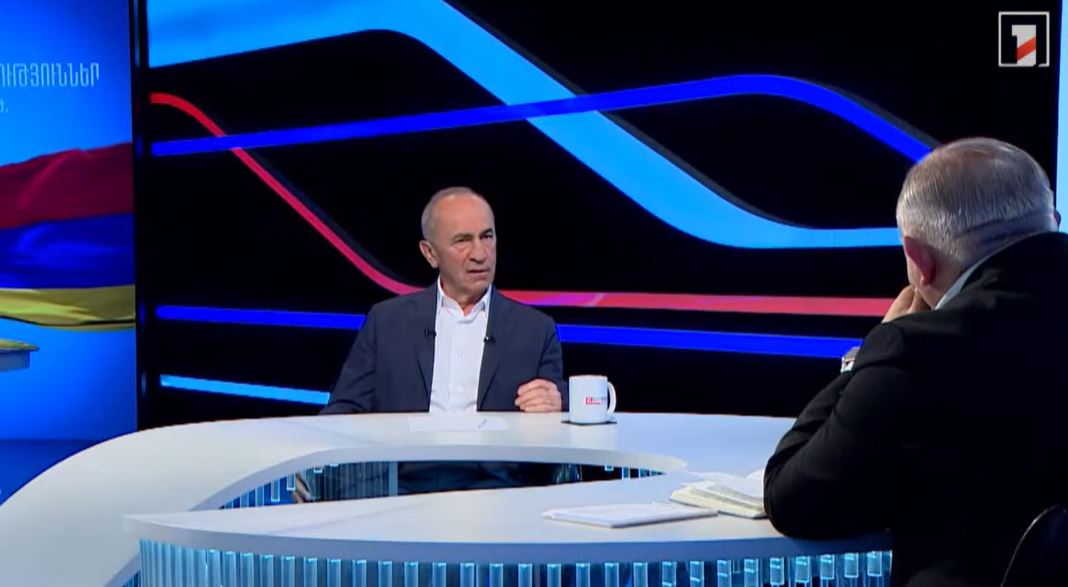
Former President Robert Kocharyan, the prime ministerial candidate of the Armenia Alliance, delivered a forceful rebuttal to several of Nikol Pashinyan’s central political narratives during a wide-ranging televised interview, challenging the government’s claims on democracy, corruption, the army, Artsakh, and Armenia’s foreign policy failures.
The interview was notable not only for its substance, but also for its setting. Petros Ghazaryan, the host of the program on Armenia’s Public Television, had not previously hosted Kocharyan on his program. Public Television, funded by the state and expected to serve the public interest, has often reflected the government’s preferred political framing during Pashinyan’s tenure. Throughout the interview, Ghazaryan repeatedly advanced questions and premises that closely mirrored the ruling party’s long-standing accusations against Kocharyan. Yet Kocharyan remained composed, methodically responding to each charge, rejecting what he described as distortions, and forcing the discussion back to facts, context, and political responsibility.
Asked about the current political environment ahead of the election, Kocharyan dismissed the notion that opposition forces exist merely to return him to power. He argued that this talking point was created by Pashinyan’s team to pressure other opposition parties into distancing themselves from him. In Kocharyan’s view, the democratic principle is clear: the political force receiving the highest number of votes has the right to nominate the prime ministerial candidate. He framed the government’s attacks as an attempt to distort the opposition field and frighten voters away from the only political force Pashinyan clearly fears.
Kocharyan also directly challenged Pashinyan’s claim that Armenia today enjoys greater democracy than in the past. He said the current government uses administrative pressure more broadly and more technologically than previous authorities, monitoring people’s public activity, including social media likes, and punishing those connected to the state system for showing sympathy toward opposition forces. He said teachers, kindergarten employees, and others tied to the public sector are being pressured or dismissed for attending opposition rallies or expressing support online.
While acknowledging that earlier elections in Armenia were not ideal, Kocharyan argued that the government’s current methods are more systematic and hidden. According to him, the state has not eliminated the old “feudal” political behavior it once condemned. Rather, the same local power networks now operate for Pashinyan’s benefit.
A major portion of the interview focused on the events of March 1, 2008, which Pashinyan and his allies have long used as a political weapon against Kocharyan. Kocharyan rejected the claim that sleeping protesters were attacked by the army, calling that version a distortion. He said security services had information that weapons and explosives were present in the protest area, and that the intended operation was a search, not an attack. He further argued that Pashinyan himself played a central role in escalating the violence by encouraging confrontation with police.
Kocharyan said he carries a general sense of responsibility as the country’s first figure at the time, but he rejected the claim that a concrete decision by him caused the tragedy. He noted that the first person killed was a police captain and asked whether any prominent opposition figure had been killed or injured, arguing that this showed there was no targeted campaign against opposition leaders. He contrasted that period with the present, pointing to opposition figures now facing arrests and criminal cases under Pashinyan.
On corruption, Kocharyan pushed back against the government’s use of inflated figures and politically charged prosecutions. He argued that many claims of “illegal assets” are built on questionable legal logic and propaganda numbers designed to shock the public. Referring to cases involving his family and former officials, he said the accusations often multiply small disputed amounts into exaggerated totals, while courts have yet to decide the facts. Kocharyan said his side will present documentation “to the last cent” and insisted that wealth acquired through business should not automatically be treated as corruption simply because a person is politically connected.
The sharpest exchanges came over national security and the collapse of Artsakh. Kocharyan rejected the claim that Armenia’s military balance had already been lost during his presidency. He argued that such calculations deliberately separate Armenia’s military potential from Artsakh’s Defense Army, even though the two functioned as one integrated defense system. According to Kocharyan, the real policy was “two states, one army,” with much of the most battle-ready equipment stationed in Artsakh because that was where the threat was concentrated.
He pointed to Azerbaijan’s own claims after the 2023 ethnic cleansing of Artsakh, saying Baku announced it had seized billions of dollars’ worth of weapons and ammunition in Artsakh. For Kocharyan, that proved the military potential existed, but was abandoned under Pashinyan’s rule.
Kocharyan argued that Pashinyan’s decisive failure was political, not only military. He said Armenia’s position had long rested on the principle that Artsakh’s people had exercised self-determination and that the international process could eventually recognize that reality. According to Kocharyan, Pashinyan destroyed that entire diplomatic structure when he recognized Artsakh as part of Azerbaijan in Prague. After that, Kocharyan said, Russian peacekeepers became little more than observers, because Armenia’s own leader had removed the political foundation that sustained Artsakh’s separate status.
He further argued that Pashinyan’s slogans, including “Artsakh is Armenia, period,” damaged the negotiation process by giving Azerbaijan an opening to claim that diplomacy had failed. Kocharyan said Aliyev saw a divided Armenian society, a damaged relationship with Armenia’s strategic ally, confusion among international mediators, and concluded that the time had come to solve the issue by force.
On relations with Russia and the CSTO, Kocharyan did not excuse Moscow’s failures, but sought to explain the consequences of Pashinyan’s foreign policy. He said Armenia’s leadership cannot repeatedly provoke or alienate a strategic partner, move toward hostile geopolitical blocs, host anti-Russian messaging from Armenian territory, and then expect that partner to prioritize Armenia’s security needs. Kocharyan was especially critical of the timing of recent anti-Russian steps and visits, calling them acts that create consequences for Armenia rather than strengthen its security.
Kocharyan also criticized Armenia’s current economic narrative. Responding to claims of growth under Pashinyan, he reminded viewers that during his own presidency Armenia’s GDP grew sixfold, the state budget increased eightfold, and public debt remained around 13 to 14 percent of GDP. By contrast, he said, today the debt burden is near 50 percent of GDP and debt servicing has become a major pressure on the state budget. He argued that any future government must audit how billions in borrowed funds were spent.
In closing, Kocharyan also criticized the political system itself, saying Armenia’s parliamentary elections are being treated as if they were presidential elections centered on one man. He argued that this “super-prime minister” model distorts parliamentary democracy and concentrates too much power in one individual, a problem made more dangerous under Pashinyan’s polarizing rule.
The interview showed Kocharyan’s central campaign message clearly: Pashinyan’s government has built its legitimacy on false narratives about democracy, corruption, war, and foreign policy. Kocharyan presented himself not merely as an opposition candidate, but as the statesman capable of restoring strategic thinking, institutional responsibility, and national security after years of slogans, division, and catastrophic miscalculation.