HOW MANIPULATIVE POLLING BECOMES ELECTORAL INFLUENCE IN THE RUN-UP TO ARMENIA’S MOST DECISIVE ELECTION
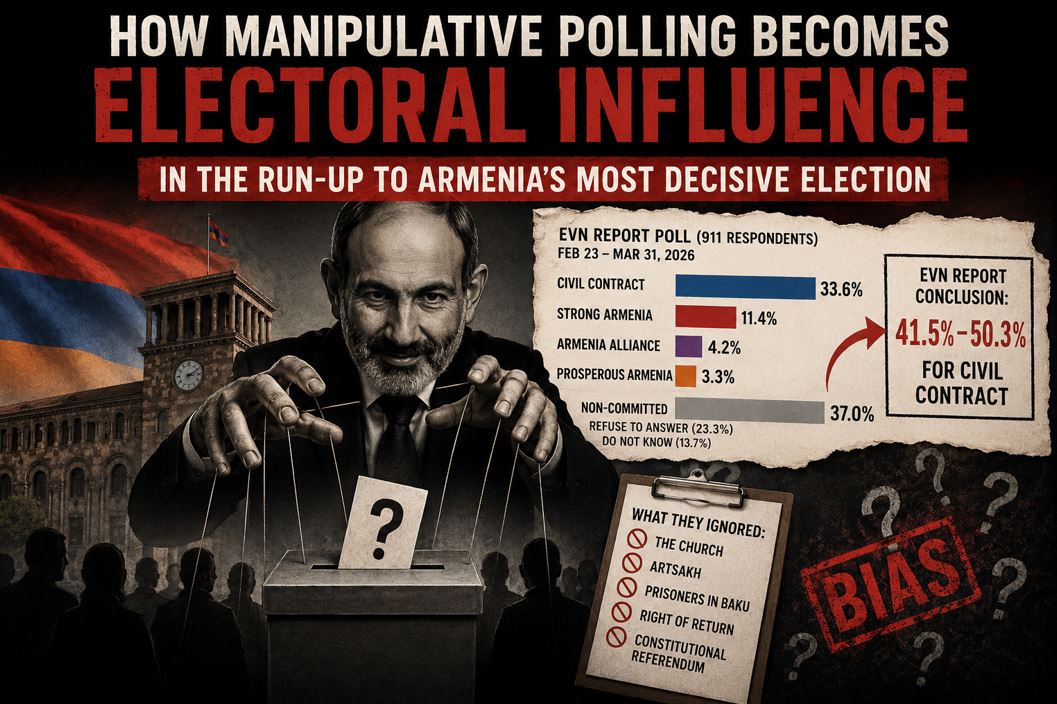
As Armenia approaches its much anticipated June 7th elections, a familiar specter has returned to the political landscape: the use of purportedly “authoritative” data to project an aura of inevitability for the ruling Civil Contract Party. On April 6, 2026, EVN Report, an outlet frequently scrutinized for its proximity to the current administration’s narrative, released polling data based on 911 respondents to an ArmES Wave 2 survey conducted from February 23 to March 31, 2026.
The raw data declared the following results:
- 33.6% for Civil Contract
- 11.4% for Strong Armenia
- 4.2% for Armenia Alliance
- 3.3% for Prosperous Armenia
- 37.0% Non-committed [Refuse-to-answer (23.3%) and Do-not-know (13.7%)]
At first glance, the top-line takeaway is that Civil Contract is well short of the 50% +1 mark. Yet, through a process of methodological alchemy, EVN Report concludes that “statistically speaking, Civil Contract, currently, has a vote share of between 41.5% to 50.3%.” This is not only inconsistent with objective polling from MPG/Gallup (01.04.2026 – 03.04.2026 period), showing Civil Contract at around 24.3%, but it is also a methodologically aggressive extrapolation that creates a “fait accompli” effect, discouraging disgruntled voters from showing up because the result is framed as “already decided” and a “done deal,” as it were, for which they needn’t vote.
The Alchemy of Extrapolation: A Layman’s Trap
The reality is that, although campaigning has unofficially begun, it is too early to predict election results with any level of statistical certainty. This is supported by the fact that the most popular answer to the survey was “non-committed” at 37%. However, instead of concluding that Pashinyan is not as popular as expected, EVN Report employs a “Layman’s Trap.” They assume that these non-committed voters will break for Pashinyan based on their alignment with four specific issues: justice, security, the TRIPP initiative, and the recent visit of US Vice President JD Vance to Yerevan.
This methodology makes major assumptions that ultimately render the polling unreliable. There are three primary issues with this type of extrapolation:
- Translation of Issue Proximity into Vote Probability: The biggest logical jump is assuming that a respondent’s stance on four issues alone provides enough evidence to predict a vote two months in advance. Reducing the probabilistic relationship of a vote to four questions is a shaky statistical approximation. Furthermore, it ignores the “Great Armenian Silence”—the fact that in a climate of heavy-handed administrative oversight, “Refuse to Answer” is often a survival strategy for opposition supporters, not an endorsement of the status quo.
- The Turnout Fallacy: EVN Report’s headline scenario rests on an 89% participation premise. This is inconsistent with previous high-stakes elections: 2017 (60.9%), 2018 (48.6%), and 2021 (49.4%). MPG’s lower participation data suggests that actual mobilization remains unresolved. In a fragmented system, who turns out matters more than temporary issue sympathy.
- Short-Run Mood Effects (Recency Bias): The survey was fielded during a distinct information cycle shaped by the Iran war and government spending announcements. These capture short-term reassurance rather than enduring partisan conversion.
Omission as an Instrument of Bias
The most damning indictment of the EVN poll is not what it asks, but what it ignores. To suggest that a voter’s intent can be predicted without asking about the Church, Artsakh, or the Constitutional Referendum is absurd and unconscionable. By (intentionally) ignoring Pashinyan’s vulnerabilities, the analysis suffers from severe omission bias and utilizes this bias for untoward ends.
The War on the Church: EVN does not include the separation of church and state in its analysis. By threatening Catholicos Karekin II and the ecclesiastical authority of Echmiadzin, Pashinyan is using his platform to thrash the church. Without analyzing how voters feel about this attack on a primary cultural fault line, the poll misses a major driver of opposition sentiment.
The Artsakh Erasure: Other issues are glaringly absent, specifically the still tortured and held hostage Artsakh Armenian leadership’s status in Baku, the right to return for Artsakh Armenians, and the constitutional referendum aimed at removing Artsakh from the national charter.
EVN Report’s Faulty Framing of “Four Issues”
Even the pillars upon which EVN Report builds its model are structurally compromised, framed with inherent biases that guide respondents toward a pro-government conclusion.
Issue 1: Justice/Accountability Question: “The current government has or has not undertaken sufficient work to hold previous government officials responsible for illicit activities?”
This framing manufactures a false dichotomy between “evil” previous regimes and a “virtuous” current administration. It deliberately narrows the field of play, failing to allow respondents to comment on whether they believe the current government’s own illicit activities or systemic failures override any considerations about punishing the past. It is a question designed to validate a vendetta, not to measure complex civic approval and is framed to present the past illicit activities as already established facts.
Issue 2: The Security Fallacy Question: “Has the security situation in Armenia improved or not improved when compared to one year ago?”
This is a classic “Recency Bias” play. By isolating the timeline to a single year, the poll prevents respondents from comparing today’s precarious borders to the pre-2020 status quo. Pashinyan employed this exact tactic in his April 16, 2026, address to Parliament, citing border casualty lists from 1996–2017 to claim the present is “safer.” One year of relative quiet on the line proves nothing about long-term stability; more importantly, it says nothing about the catastrophic losses of the 2020 war (5.000 plus murdered, 10,000 plus maimed) or reporting that shows Aliyev continues to lay claim to Syunik, Yerevan, and much of Armenia as “Western Azerbaijan.”
Issue 3: TRIPP (The Economic Mirage) Question: “TRIPP is beneficial to Armenia because it will bring economic growth and stability or TRIPP is not beneficial to Armenia because it will not bring economic growth or stability?”
TRIPP remains a premature and poorly understood concept for the average citizen, yet the question forces a binary choice on “stability” that ignores the cost. To many critics, this “growth” comes at the expense of a US-brokered NATO expansion that threatens to sever Armenia’s vital land border with Iran—a high price for a vague promise of prosperity. Furthermore, the survey assumes that the TRIPP initiative is tied to Pashinyan personally. It begs the question: Is the United States building a strategic relationship with the state of Armenia, or merely with the current administration?
Issue 4: The Geopolitical Scare Tactic Question: “Vice President Vance’s visit was positive for Armenia, Vance’s visit was negative for Armenia, and Vance’s visit was neutral for Armenia?”
This is “Hostage Diplomacy” via spreadsheet. EVN Report operates on the faulty premise that a positive view of Vice President Vance’s visit is synonymous with a vote for Civil Contract. This reinforces the government’s favorite misnomer: that Western support is a personal gift to Nikol Pashinyan that would evaporate under any other leadership. There is no evidence to suggest that the U.S. would abandon its regional interests or existing agreements if the opposition won. This framing seeks to transform the incumbent from a political leader into an indispensable, and sole, shield against total isolation.
The Post-Election Strategic Horizon
If, as the data suggests, no single party reaches the 50% +1 threshold on June 7, the battle shifts from the polling station to high-stakes strategic maneuvers within Armenia’s complex electoral code.
Armenia’s electoral code utilizes two primary tools to ensure a governing majority:
- The Stability Top-Up: A first-round mechanism that can raise a single party or a pre-declared coalition from just over 50% to roughly 52% of the seats to ensure a “stable” working majority.
- The Runoff Mechanism: A second-round fallback that guarantees a majority if no governing coalition can be formed in the immediate aftermath of the first round.
The code provides a six-day window for parties to form a governing coalition. If a single party or a bloc fails to secure a majority in the first round, the opposition—principally Strong Armenia, the Armenia Alliance, and Prosperous Armenia—must be prepared for a “Unity Consolidation” strategy. Pragmatically, if these forces can collectively assemble a bare majority (between 50% and 52%), the law allows them to bypass the destabilizing risk of a runoff and form a government immediately. But what remains uncertain is whether any “top-up” applies, or should apply, to such coalitions.
Ultimately, the Armenian electorate must look past the desperate attempts by outlets aligned with the current administration like EVN Report to portray a Civil Contract victory as an inevitability. The reality is clear: the ruling party has failed to secure a clear mandate and if even a fraction of the non-committed block breaks for the opposition, a silent plurality of 37% can swing this election in the opposition’s favor.
The Center for Armenian Research and Analysis is a trans-national institute that provides investigative, analytic, and informational resources to public and private entities across the Armenian experiential spectrum.