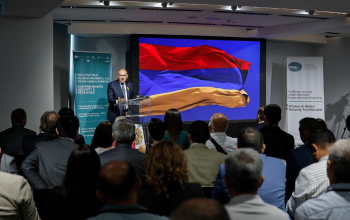
Prime Minister Nikol Pashinyan once again avoided directly identifying Ottoman Turkey and the Young Turk regime as the architects and executors of the Armenian Genocide, as Armenia marked the 111th anniversary of the 1915 massacres on Friday.
In his official April 24 message, Pashinyan placed unusual emphasis on the Armenian term Meds Yeghern—the “Great Crime”—while using the internationally recognized term “genocide” only sparingly. His wording echoed a pattern long used by foreign leaders seeking to avoid direct recognition of the Armenian Genocide, including U.S. President Donald Trump, who has also relied on the phrase Meds Yeghern in past April 24 statements.
Rather than clearly attributing responsibility to the Ottoman Turkish authorities who organized and carried out the extermination campaign, Pashinyan suggested that Armenians of the Ottoman Empire had been drawn into the “international intrigues” of outside powers during World War I. His statement framed the catastrophe as the result of Armenians being pulled into geopolitical rivalries, rather than as a deliberate state policy of annihilation by the Ottoman government.
“Today we commemorate the victims of the Armenian Genocide of 1915, the Meds Yeghern, and pay tribute to our compatriots who were subjected to massacre, deportation, and starvation in the Ottoman Empire for being Armenians,” Pashinyan said. He added that the Meds Yeghern was “the greatest tragedy” to befall the Armenian people, one that Armenians have relived for 111 years.
Yet the statement made no mention of the Young Turk regime, which ruled the Ottoman Empire at the time and oversaw the deportations, massacres, starvation, and destruction of the Armenian population. Instead, Pashinyan described the genocide as a consequence of “the practice of involving the Armenian people in international intrigues,” a formulation widely understood as a reference to the Russian Empire and European powers.
The prime minister also warned that Armenia “cannot allow the Meds Yeghern to become a tool for international players to fight against each other,” further reinforcing his government’s shift away from the traditional Armenian position that international recognition of the Genocide is a matter of historical truth, justice, and national dignity.
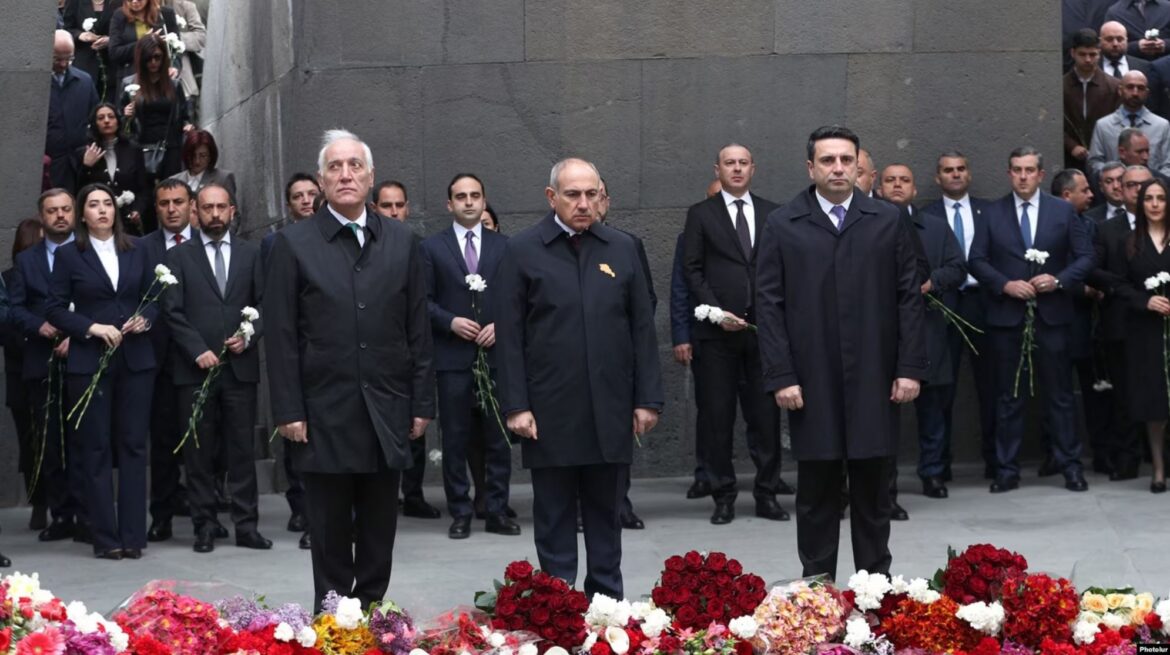
The remarks came as tens of thousands of Armenians marched to the Tsitsernakaberd Memorial in Yerevan throughout the day to honor the memory of the 1.5 million Armenians killed during the Genocide. Pashinyan led the official wreath-laying ceremony earlier in the day.
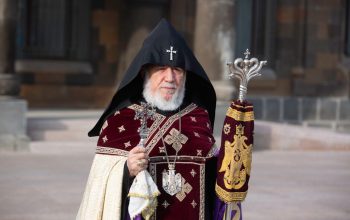
Catholicos Garegin II, the Supreme Patriarch and Catholicos of All Armenians, was again excluded from the official state ceremony, amid Pashinyan’s ongoing campaign against the Armenian Apostolic Church and its leadership. Garegin II and senior clergymen later held a separate prayer service at Tsitsernakaberd, but Armenian state television did not broadcast the service during its live coverage from the memorial.
The Armenian Genocide began on April 24, 1915, with the arrests of Armenian intellectuals, political leaders, clergy, and community figures in Constantinople. It was followed by mass deportations, massacres, forced marches, starvation, and systematic destruction across the Ottoman Empire. Roughly three dozen countries, including the United States, France, Germany, and Russia, have formally recognized the Armenian Genocide.
Pashinyan’s latest statement continues a pattern that has alarmed Armenian historians, opposition figures, diplomats, and public leaders. In January 2025, he said Armenians must “understand what happened” in 1915 and questioned what led to the international recognition campaign in later decades. Critics said the comments appeared to cast doubt on the legitimacy of the Armenian Cause and suggested that diaspora-led recognition efforts had been driven by Soviet or foreign agendas.
Opponents have accused Pashinyan of softening Armenia’s position on the Genocide in order to appease Turkey, which continues to deny that the Ottoman state carried out a deliberate campaign to destroy its Armenian population. Pashinyan has also made clear that his government will not actively pursue further international recognition of the Genocide, even questioning whether foreign parliamentary resolutions on the matter contribute to regional stability.
Opposition leaders sharply criticized Pashinyan’s approach on Friday, saying that a future government would restore the pursuit of international recognition and justice for the Armenian Genocide as a central pillar of Armenia’s foreign policy.
“Armenia’s current leaders are trying to justify the perpetrators of the Armenian Genocide,” said Samvel Karapetian, whose opposition bloc is expected to be one of Pashinyan’s main challengers in the upcoming parliamentary elections. “Moreover, they are trying to equate the victim and the executioner.”
Former President Robert Kocharian, who leads another major opposition force, issued a shorter but equally pointed message: “Nothing will be forgotten.”
Pashinyan’s April 24 statement has therefore deepened concerns that Armenia’s current authorities are not merely pursuing a policy of normalization with Turkey, but are gradually abandoning the historical, moral, and political foundations of the Armenian people’s demand for truth, justice, and accountability.