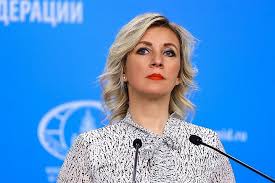
MOSCOW—Russian Foreign Ministry spokesperson Maria Zakharova responded to Azerbaijan’s latest objections over Moscow’s use of the term “Nagorno-Karabakh,” pointing to what she described as a contradiction in Baku’s position.
Speaking at a press briefing, Zakharova was asked about a recent statement by Azerbaijan’s Foreign Ministry effectively urging Russia to stop using the term. In response, she noted that Azerbaijan itself routinely comments on issues involving territories Russia now considers part of its own state, while continuing to describe them as part of Ukraine.
Zakharova also stressed that Russia, including President Vladimir Putin personally, has played a central role for decades in efforts related to the Nagorno-Karabakh conflict. According to her, Moscow’s involvement dates back to the 1990s and remained consistent throughout the various stages of the conflict.
She said Russia’s efforts were instrumental in halting the bloodshed during the autumn 2020 war and recalled that Russian peacekeepers remained in the region for nearly four years to maintain the ceasefire.
According to Zakharova, Russia’s involvement also helped create the basis for the current phase of Armenian-Azerbaijani normalization. She said that process has moved forward along several major tracks and has relied heavily on the trilateral agreements reached at the highest level between 2020 and 2022.
Zakharova also referenced the October 6, 2022 summit in Prague held under European Union auspices. She noted that the statement adopted there formalized Armenia’s and Azerbaijan’s recognition of each other’s territorial integrity on the basis of the UN Charter and the 1991 Alma-Ata Declaration.
At the same time, she said Moscow took note of the fact that in recent years Yerevan and Baku have increasingly preferred direct talks without intermediaries. Russia, she said, has treated that approach with understanding while continuing to support what it calls constructive steps by both sides aimed at securing long-term peace and stability in the South Caucasus.
Zakharova also highlighted the August 2025 initialing of the text of the agreement on peace and interstate relations between Armenia and Azerbaijan. She further noted that, from an institutional standpoint, the issue of the Nagorno-Karabakh conflict settlement was effectively brought to a close through an OSCE decision that set in motion the dissolution of the Minsk Process structures beginning on December 1, 2025. Moscow, she added, supported that decision.
Still, Zakharova said much remains unresolved. She pointed to the need for a final peace treaty, the reopening of regional transport and economic links, the delimitation and demarcation of the Armenia-Azerbaijan border, and broader efforts to build trust between the Armenian and Azerbaijani peoples.
She said Russia remains ready to assist in all of those areas to the extent that both Yerevan and Baku seek such involvement.
Zakharova concluded by saying that the present stage requires consolidation of what has already been achieved and expressed hope that the normalization process will become truly irreversible—in what she described as the positive sense of that term.