By Juliette Davtian
Throughout history and even today, religion has shown an extraordinary ability to shape political power, challenge governments, and influence conflicts often more deeply than armies or laws.
In the Israel–Palestine conflict, religion is deeply intertwined with land, identity, and historical narratives. Sacred sites like Jerusalem are not just political symbols but religious ones, making compromise far more complex and emotionally charged on all sides.
In Northern Ireland, decades of conflict were fueled not only by politics but by religious identity, where Catholic and Protestant affiliations shaped allegiance, resistance, and reconciliation.
In Iran, religious authority has directly defined the state since the 1979 Islamic Revolution. Clerics hold ultimate power over elected officials, illustrating how religious legitimacy can supersede democratic structures and influence national policy.
In India, religious nationalism has transformed politics in recent decades, shaping laws, debates over citizenship, and social relations among religious groups, demonstrating how faith can energize majorities and reshape national identity.
In Poland, the Catholic Church played an essential role in opposing communist rule, backing the “Solidarity” movement and showing how religion can strengthen nonviolent resistance against authoritarian regimes.
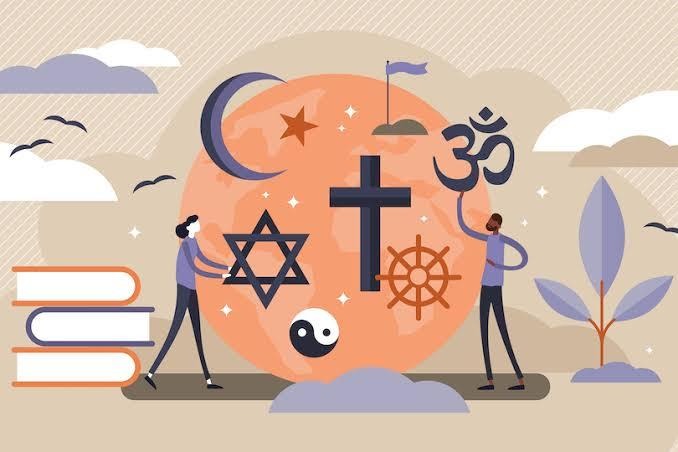
These examples remind us that religion is not just a personal belief system; it can be a powerful social force capable of legitimizing authority, resisting oppression, uniting communities, or deepening divisions. Grasping its influence is vital for understanding global politics and conflict today.
Religion at the Individual Level
At the individual psychological level, religion functions as a powerful source of meaning, identity, and moral guidance. According to meaning-making theories (e.g., Viktor Frankl), people seek coherent narratives that explain suffering, injustice, and collective struggles. Religion provides such narratives, especially during conflicts or periods of political uncertainty, helping individuals interpret events not merely as political outcomes but as morally and existentially meaningful.
Authored by Tajfel & Turner in 1979, Social Identity Theory further clarifies this link by demonstrating how religious affiliation becomes a prominent ingroup identity, especially when perceived threats arise. When individuals face political instability, occupation, or cultural marginalization, their religious identity often deepens, enhancing emotional bonds and willingness to defend sacred values. This psychological mechanism helps explain why religious institutions can rally mass support more effectively than secular authorities.
Additionally, religion influences moral thinking by classifying political issues as sacred or non-negotiable. When beliefs or territories are regarded as sacred, compromise can feel like moral betrayal rather than a practical solution. This explains why religious conflicts often persist, as people see them not just as external disagreements but as threats to their core identity.
Finally, religion provides psychological resilience. Rituals, collective worship, and shared belief systems promote emotional regulation, social support, and a sense of transcendence beyond immediate hardship. These mechanisms strengthen loyalty to religious institutions, helping them stay influential, even resistant, when faced with state power or political pressure.
Conclusion
Religion is not just a personal belief but also a powerful force that can unite or divide, influence politics, and shape identity. Understanding its impact enables a deeper understanding of both government policies and individual behavior and identity development. Recognizing the role of religion is crucial for understanding modern geopolitical issues as well as personal psychology and actions.
Sources
- Encyclopedia Britannica. (2024). Religion and politics. https://www.britannica.com
- Oxford Research Encyclopedia. Fox, J. (2018). Religion and politics. Oxford Research Encyclopedia of Politics. https://doi.org/10.1093/acrefore/9780190228637.013.94
Tajfel, H., & Turner, J. C. (1979). An integrative theory of intergroup conflict. In W. G. Austin & S. Worchel (Eds.), The social psychology of intergroup relations (pp. 33–47). Brooks/Cole.