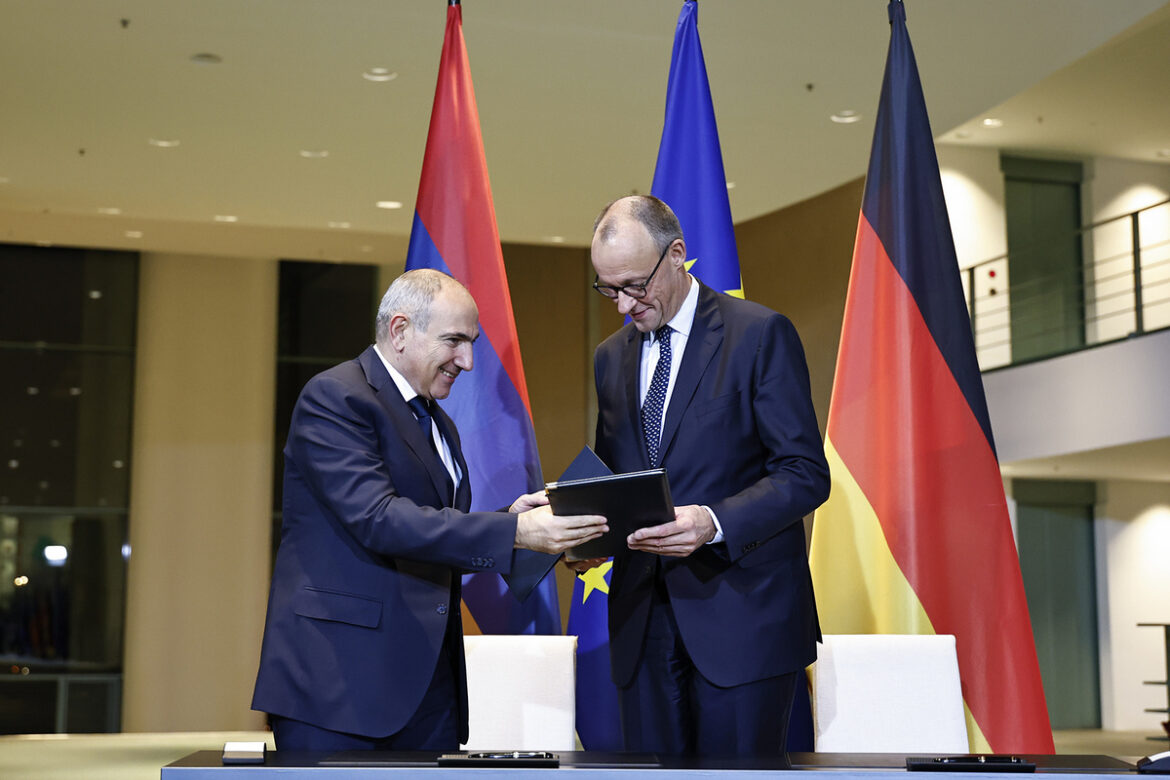
German Chancellor Friedrich Merz accused Russia of trying to destabilize Armenia ahead of its parliamentary elections, following talks with Prime Minister Nikol Pashinyan in Berlin late Tuesday.
“It has become an almost disturbing norm that elections are attacked by the enemies of democracy,” Merz said at a joint news conference. “Russia, in particular, is trying to instill fear in Armenian voters about too close a relationship with Western partners. It is spreading falsehoods about the goals and values of the European Union.”
Merz also claimed that “disinformation, sabotage, drones” were among the “hybrid tactics” Russia is using “not only against Europe but also against Armenia,” though he did not provide specific examples. Similar language has been used by Western officials in recent years when commenting on elections and political developments in countries such as Moldova and Georgia.
Pashinyan, while not directly endorsing the accusation of Russian interference, referred more generally to “hybrid threats” facing democratic states. Asked by a reporter whether he believes Russia is interfering in Armenia’s elections, due next June, he declined to give a direct answer, saying only that his government would counter “flows of disinformation” through “active dialogue with our people.”
Last week, the European Union’s foreign and security policy chief, Kaja Kallas, also accused Russia of spreading election-related disinformation in Armenia. The Russian Foreign Ministry strongly rejected the allegation.
“Their statements once again prove that Brussels’ only goal in interacting with Yerevan is, in fact, to damage Armenia’s relations with Russia,” Foreign Ministry spokeswoman Maria Zakharova said, dismissing the EU position as politically motivated. Similar Russian responses have followed Western accusations in other post-Soviet states, including Moldova and Georgia, where Moscow has also denied claims of interference.
Despite rising tensions with Yerevan, Moscow has publicly tried to present relations as stable. Russian President Vladimir Putin said in September that Russian–Armenian ties are developing “in all areas.”
Frictions have increased, however, since the Armenian government pushed through a law this spring declaring “the start of a process of Armenia’s accession to the European Union.” Pashinyan referred to that law in his remarks after the talks with Merz.
“In this context, I highly value Germany’s support for deepening the Armenia–EU partnership, expecting continued political support on our difficult and lengthy path to the European Union,” he said.
Merz welcomed Armenia’s intention to move closer to the EU but stopped short of explicitly supporting eventual membership, noting that countries seeking to join the 27-member bloc must meet “quite a few conditions.”
Russian officials have repeatedly warned that an EU membership bid could have serious economic consequences for Armenia. According to official statistics, Russia accounted for more than 35 percent of Armenia’s foreign trade in the first half of this year, compared with the EU’s 12 percent share. Armenia also imports most of its natural gas from Russia at prices set below international market levels.
Against this backdrop, statements from Berlin and Brussels about Russian “disinformation” and “hybrid tactics” place Armenia inside the same narrative framework previously applied to Moldova and Georgia, where Western officials have likewise portrayed Moscow as the primary factor destabilizing the political environment around elections and European integration.