By Andranik Aboyan
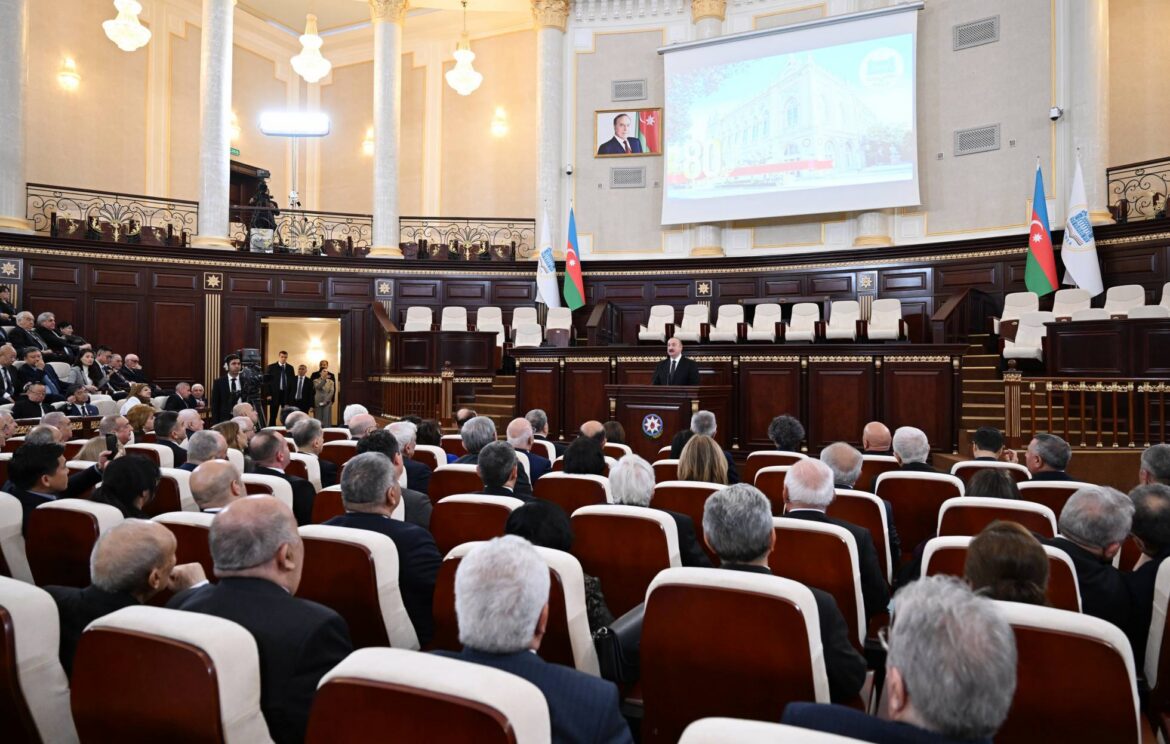
At the 80th anniversary of Azerbaijan’s National Academy of Sciences, Ilham Aliyev revived the call for the “return” of ethnic Azerbaijanis to the Republic of Armenia, presenting it as an unthreatening prospect. Armenia’s leadership, pointing to understandings reached in Washington in August, treated the remarks as domestic posturing and insisted that Yerevan is not seeking the return of Armenians to their homes in Artsakh. The border, officials say, has been quieter; the language of peace keeps its place in the communiqués.
What is heard beneath the reassurance is an old melody. First the territory is emptied, then the emptied space is renamed “normalization,” and then a humanitarian theme is introduced to accompany the advance. Euphemism appears as policy’s etiquette: a newly created absence asks to be filled, and those who created the absence volunteer to curate the filling.
Equivalence is the instrument. One displacement is laid next to another until the differences no longer obstruct the view. But if we resist the smoothing, a different pairing emerges: the fate of Artsakh Armenians rhymes, historically and morally, with the fate of Armenians from Baku and Sumgait—lives uprooted under the shelter of organized fury, exits arranged by threat. To place against them the Azerbaijanis who once lived in Armenia is an accounting trick: two columns that meet on paper because the ink is the same, not because the events are.
The promise of “return” without the grammar of law is only a promise to keep talking. Borders unrecognized, guarantees unsaid, crimes undefined—yet movement is proposed, study committees are convened, learned societies are instructed to verify a destiny already chosen. Scholarship is given the task of discovering what power requires. Maps are held up like documents of conscience when they are merely the archive of previous winners.
On the Armenian side, the language of management helps the process along. “Don’t overreact, don’t provoke, let the process work”—a vocabulary adequate to budgets and tenders, now assigned to memory and vulnerability. When memory is displaced from the negotiating table, the only remaining interpreter of reality is the “fact on the ground,” and facts, left to themselves, do not confess.
Peace cannot be assembled from gestures. Its parts are heavier: recognition that does not shift by season; renunciation that stays renounced; institutions that are permitted to protect the weak even when this inconveniences the strong. Any talk of cross-border returns that does not begin with the people emptied by blockade and terror—Artsakh Armenians, survivors of Baku and Sumgait—and bind their safety to enforceable terms, is a choreography arranged for observers.
Aliyev celebrates victory as total and history as pliable; experts are invited to polish both. This is the order of things when force wishes to retire into routine. The task is to refuse the illusion that routine absolves. Names must be kept where they belong—in the text, not the footnote—so that what is being proposed can be seen for what it is: a program seeking hospitality in the language of healing.
The news remains the news. But the form in which it arrives—soothing, confident, already documented—should not instruct us to forget how the stage was cleared.